15 AI Marketing Ideas That Move Revenue for Small Service Firms
15 AI Marketing Ideas That Move Revenue for Small Service Firms
The fastest path to AI marketing results is running a short list of measurable campaigns that plug into channels you already run: content, email, ads, and personalization. Skip the platform overhauls and the six-month data science hires. Pick a few ideas from the list below, brief them tightly, test them against a control, and scale only what beats it. That’s the whole strategy.
TL;DR:
- Running targeted, measurable campaigns that connect to existing channels yields faster results than platform overhauls or hiring data scientists.
- Using scored ideation and quick AI-generated email sequences can produce tested, scalable campaigns without extensive technical resources.
- Prioritizing metrics like conversion rate lift, cost per acquisition, and revenue per visitor is essential to measure actual marketing success.
- Small businesses should integrate AI tools with operational systems to streamline campaign management and customer data use.
- Human review remains critical for customer-facing content, especially on sensitive topics, before AI output goes live.
Table of Contents
- AI Marketing Ideas Worth Running This Quarter
- From Idea to Live Campaign: A Five-Step Workflow
- Choosing the Right AI Tools and Measuring What Matters
- Brief Template, Ideation Workflow, and Prompts You Can Reuse
- What Actually Separates Winning AI Campaigns From Wasted Budget
- A Simpler Way to Run AI Campaigns Without Adding Headcount
- Sources
- FAQ
AI Marketing Ideas Worth Running This Quarter
Most “AI marketing” advice stalls at generic suggestions like “use AI for content.” That’s not a strategy; it’s a category. What follows are specific, scoped campaign concepts, each with an example execution and the tool category that runs it. None of these require a data science team. Most need a generative copy tool, a personalization engine, or an automation platform you can license by the month.
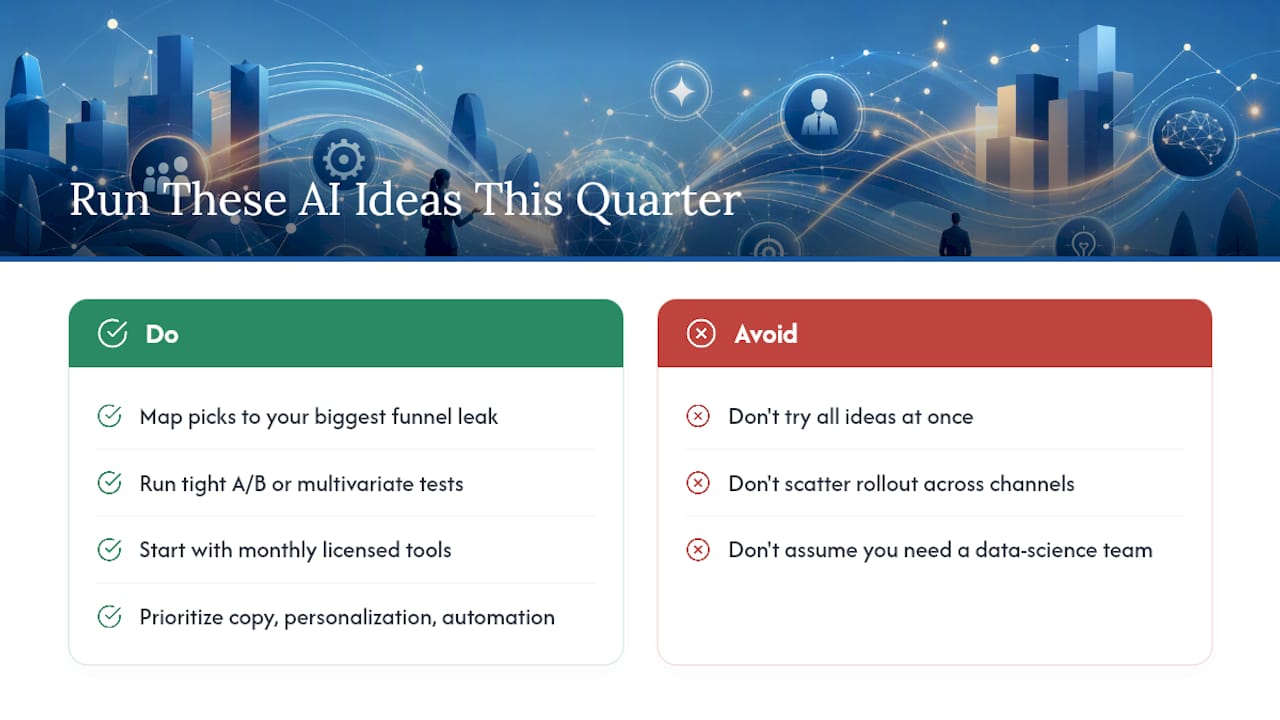
Pro Tip: Don’t try all ideas at once. Pick some that map to your biggest funnel leak, whether that’s low email open rates or a stalled ad account, and run those first. A tight test beats a scattered rollout every time.
1. Scored Campaign Ideation (12 Concepts, Not One)
Instead of asking a generative tool for “a campaign idea,” ask it for twelve, scored against reach, cost, and differentiation. A scored ideation workflow using a three-axis rubric produces more testable, differentiated concepts than open brainstorming or single-shot prompting. Example execution: A regional HVAC company feeds its audience profile and seasonal goal into a large language model, generates twelve concepts scored on cost, reach, and novelty, then greenlights the top three for creative development. Tools: generative copy/ideation assistant with a structured prompt template.
2. AI-Written, Human-Approved Email Nurture Sequences
Generative tools now draft full nurture sequences, five to seven emails, branching on subscriber behavior, in under an hour. Example execution: An online furniture retailer builds a nurture flow for cart abandoners: email one recovers the cart, email two adds social proof, email three offers a time-limited discount, each variant generated and then edited by a human for tone. Tools: generative copy tool paired with your email service provider’s automation builder.
3. Dynamic On-Site Personalization
Personalization engines swap headlines, product grids, or hero images based on visitor behavior, referral source, or past purchases, without a developer touching the page each time. Example execution: A subscription skincare brand shows first-time visitors an educational landing page and returning visitors a reorder shortcut, both served from the same URL. Tools: personalization/onsite optimization engine integrated with your CMS.
4. Automated Ad Creative Variation and Multi-Armed Testing
Rather than manually building ten ad variants, generative tools produce dozens of headline, image, and copy combinations, then a multi-armed testing system shifts spend toward winners automatically instead of waiting for a fixed sample size. Example execution: A local gym chain generates 20 headline and image pairings for a single offer, launches them simultaneously, and lets the ad platform’s optimization engine reallocate budget every 48 hours. Tools: generative creative tool plus the native testing engine inside your ad platform.
5. AI-Assisted SEO Briefs and Content Clusters
Generative research tools can map a topic cluster, competitor gaps, and search intent in minutes, turning a vague content calendar into a structured brief a writer can execute same-day. Example execution: A plumbing contractor’s marketing lead generates ten cluster briefs around “water heater replacement,” each with target intent, suggested headers, and internal linking targets, then hands them to a freelance writer. Tools: AI research/briefing tool integrated with your keyword research platform.
6. Autonomous Social Posting With Trend-Based Hooks
Social scheduling tools with built in generation now suggest post angles based on trending formats in your niche, not just a blank content calendar. Example execution: A boutique fitness studio’s assistant flags a trending audio format, drafts three caption variants tied to a current class offer, and queues them for review before publishing. Tools: social scheduling platform with generative caption and trend-detection features.
7. Predictive Lead Scoring and Routing
Predictive models rank inbound leads by likelihood to convert using firmographic and behavioral signals, then route the hottest leads to sales reps instantly instead of sitting in a shared queue. Example execution: A commercial cleaning company scores leads based on company size, page visits, and form fields, auto-assigning anything above a threshold score directly to a senior rep’s calendar. Tools: predictive scoring model built into your CRM or a standalone lead-scoring add-on.
8. Churn-Prevention Re-Engagement Sequences
Predictive tools flag accounts showing early churn signals, drop in login frequency, unopened invoices, before cancellation happens, triggering a targeted win-back sequence automatically. Example execution: A software company for landscaping crews flags accounts that haven’t logged a job in three weeks and triggers a check-in email plus a discounted upgrade offer. Tools: predictive/behavioral scoring model connected to your email automation platform.
9. UGC Repurposing With Automated Captions and Edits
Video and caption generation tools can take raw customer footage or reviews and turn them into polished short-form clips with captions, without a video editor on staff. Example execution: A meal-kit brand collects customer unboxing videos and runs them through an automated caption and clip tool to produce fifteen-second social ads by Friday afternoon. Tools: AI video editing/captioning tool.
10. Automated Influencer Outreach Briefs
Generative tools draft personalized outreach messages and campaign briefs at scale, referencing an influencer’s recent content instead of sending a generic pitch. Example execution: A skincare brand generates fifty personalized outreach emails referencing each creator’s most recent post, cutting outreach time from a full day to under an hour. Tools: generative copy tool with a CRM or spreadsheet-based personalization merge.
11. AI-Powered Landing Page Variants by Segment
Instead of one landing page for every ad, generative and personalization tools build segment-specific variants, different headline, proof point, and offer for each audience. Example execution: A moving company runs three ad sets (local moves, long-distance, commercial) each pointing to a landing page with copy tuned to that segment’s pain point, generated from the same base template. Tools: generative copy tool integrated with a landing page builder that supports dynamic content blocks.
12. Micro-Experiments for Creative Hooks
Rather than testing full campaigns, run small, fast experiments on just the hook, the first line of an ad or email, since that’s what determines whether anyone reads further. Example execution: A roofing company tests five opening lines for the same offer across a small ad spend, kills the bottom three after 48 hours, and scales the winner into the full campaign. Tools: generative copy tool plus your ad platform’s built-in A/B testing.
13. Automated Review Synthesis Into Testimonials
Generative tools scan customer reviews and support tickets, pulling recurring themes and phrases into ready-to-use testimonial snippets and case study drafts. Example execution: A pest control company feeds 200 Google reviews into a summarization tool, which surfaces the five most-repeated phrases customers use (“same day”, “no mess”) and turns them into headline copy for the homepage. Tools: generative summarization tool.
14. Automated Localization for Paid Channels
Generative translation and copy tools adapt ad copy for regional dialects and cultural context, not just literal translation, so multi-market campaigns launch faster. Example execution: A franchise brand operating in five metro areas generates locally-flavored ad copy variants that reference each city by name and local landmark, all from one master ad. Tools: generative localization tool integrated with your ad platform’s bulk upload feature.
15. Agentic Automation for Repetitive Campaign Ops
Agent-style tools now handle recurring, rules-based campaign tasks, budget pacing checks, weekly reporting pulls, audience list refreshes, freeing up hours that used to go to spreadsheet maintenance. Google’s own guidance on the current phase of marketing describes this shift as agentic systems moving value from passive content generation to active discovery and conversion. Example execution: A marketing manager at a small accounting firm sets up an agent to pull weekly ad performance into a shared report every Monday morning, a task that used to eat an hour of manual work. Tools: agentic workspace or workflow automation platform with reporting integrations.
These fifteen ideas aren’t a checklist to exhaust. Independent practitioner writeups on running AI growth plays without the hype consistently point to the same pattern: the plays that stick are the ones a single person can run with a small budget and a clear metric, not the ones that require a six-person rollout.
From Idea to Live Campaign: A Five-Step Workflow
Picking an idea is the easy part. Most AI marketing efforts stall between “we picked an idea” and “we have results to show,” usually because nobody wrote down what success looks like before hitting generate. Here’s the workflow that avoids that trap.
- Write the brief first. Define the audience, the product or offer, the single metric you’re trying to move, and anything the campaign must not do (no discount language, no competitor comparisons, whatever your brand rules require).
- Choose the tool category, not the tool. Decide whether this idea needs generative copy, a personalization engine, predictive scoring, or an agentic workflow tool before you shop vendors. Category first prevents buying a platform that does everything except what you actually need.
- Generate under constraints. Feed the tool your brief, not a blank prompt. Constrained generation, specific audience, specific goal, specific tone, produces usable drafts on the first or second pass instead of the tenth.
- Set up the experiment and the measurement. Every AI-generated variant needs a control to beat. Decide your minimum runtime before launch (a week of live data beats three days, even when early numbers look exciting) and define what an early-stop signal looks like, a variant underperforming control by a wide margin after a meaningful sample size.
- Iterate and scale only the winner. Kill what loses, scale what wins, and feed the result back into your next ideation round so the next brief starts smarter than the last one.
Harvard Business Review’s framework for designing an AI marketing strategy makes the same point from a different angle: AI capability only pays off when it’s tied to a specific marketing goal and a specific data source, not deployed as a general-purpose tool and hoped into relevance.
Pro Tip: *Before any campaign launches, write down what would make you stop it.
Before you brief anything, run through this checklist:
- Audience defined narrowly enough that “success” means something specific, not “everyone who visits the site.”
- One KPI, not five. Pick conversion rate, cost per acquisition, or revenue per visitor, not all three at once.
- A do-not-repeat list of phrases, claims, or formats your brand won’t use, handed to the tool up front.
- Brand guardrails, tone, banned words, required disclaimers, built into the prompt or workflow, not fixed after the fact.
- A minimal data and consent check confirming any customer data feeding the tool is something you’re allowed to use that way.
- A rollout plan: who approves output before it goes live, and how fast a losing variant gets pulled.
Choosing the Right AI Tools and Measuring What Matters
The tool category matters more than the brand name on the login screen. GWI’s analysis of marketing tool preferences found that marketers increasingly favor agentic workspaces and marketing-specific products that enforce brand voice automatically, over raw machine learning platforms that need a data science team to configure. That preference isn’t about convenience alone. It’s about governance: a tool built for marketers has brand voice controls and approval workflows baked in; a general-purpose model doesn’t.
When evaluating a tool, weigh these factors against each other rather than picking the flashiest demo:
- Integration with your existing CRM, email platform, and ad accounts. A brilliant tool that requires manual data exports is a bottleneck, not a solution.
- Brand governance controls, tone settings, banned phrase lists, approval gates, that keep output on-brand without a human rewriting every line.
- Unit economics. Know the per-use or per-seat cost before scaling. A tool that costs $0.40 per generated asset adds up fast across a thousand-email nurture sequence.
- Data access and accuracy controls. Does the tool cite sources for claims it generates? Can you audit what it pulled from and when?
On measurement, resist the urge to track everything. The metrics that actually prove an AI campaign worked are the ones tied to revenue or a clear proxy for it: conversion rate lift against a control, cost per acquisition, revenue per visitor, and customer lifetime value uplift for retention plays. Engagement metrics, click-through rate, time on page, matter as diagnostic signals, but they’re not the finish line. A campaign with a great click-through rate and a flat conversion rate didn’t work, it just got attention.
Brief Template, Ideation Workflow, and Prompts You Can Reuse
A one-page brief keeps every AI-assisted campaign consistent. Cover five fields: audience (who, specifically), product or offer, goal plus the one metric that proves it, constraints (banned phrases, required disclaimers, tone), and a do-not-repeat list from past campaigns.
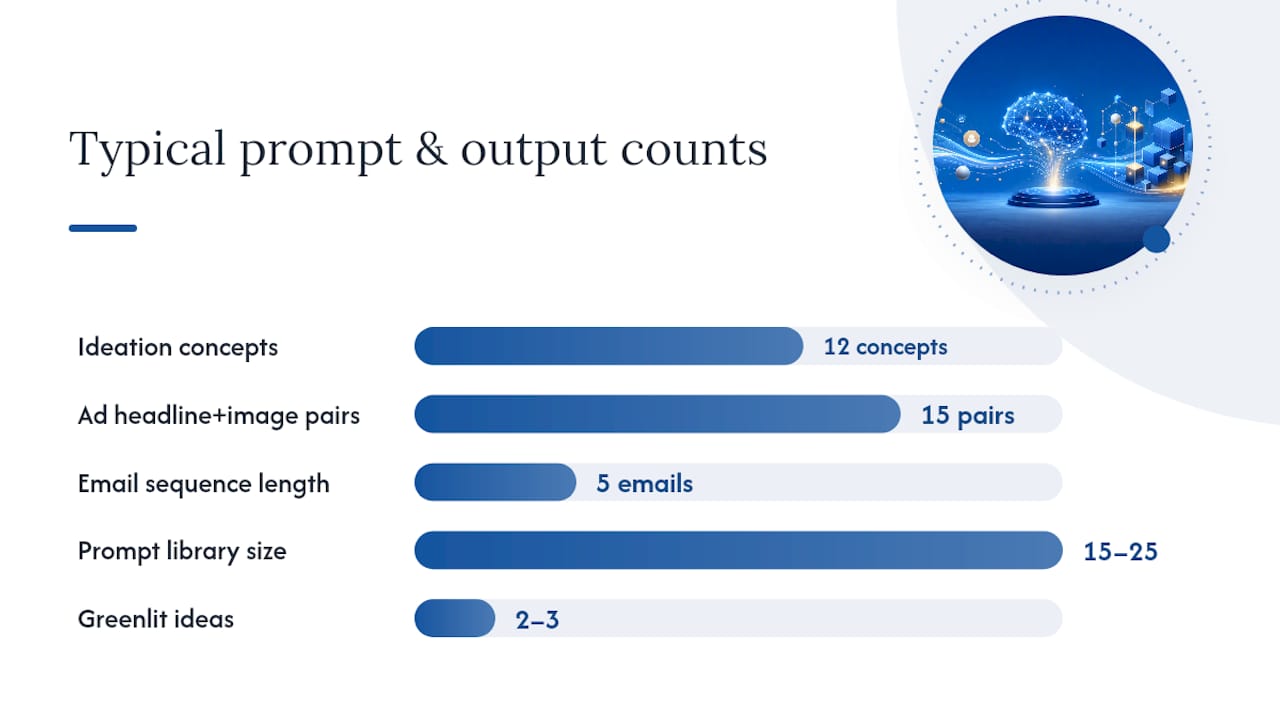
The scored ideation approach behind idea #1 works like this: generate twelve concepts, score each on reach, cost to produce, and differentiation from what you’ve already run, then greenlight only the top two or three. Standardized prompt libraries covering fifteen to twenty-five recurring workflows, research, email drafts, ad variation, reporting, cover most of what a small marketing team needs without reinventing a prompt every week.
Three prompt categories worth building into your own library:
- Ideation prompt: generate twelve campaign concepts for [audience] promoting [offer], scored on reach, cost, and differentiation from [past campaign].
- Email sequence prompt: draft a five-email nurture sequence for [segment], each email addressing one objection, ending with [specific CTA].
- Ad variation prompt: generate fifteen headline and image pairing concepts for [offer] targeting [audience], avoiding [banned phrases].
What Actually Separates Winning AI Campaigns From Wasted Budget
Most guidance on this topic treats AI marketing like a tooling problem: pick the right platform, and results follow. That’s backwards. The teams getting real returns treat it as a measurement discipline first and a tooling choice second. They run fewer campaigns, measure them tighter, and kill losers faster than the teams generating twice as much content and tracking none of it against a control.
Human review still matters most for anything customer-facing on sensitive topics, pricing, health claims, financial guidance, where a wrong or tone-deaf AI-generated line does real damage. If your team doesn’t have a clear approval step before AI output goes live, that’s the first gap to close, before buying another tool. Outsourcing makes sense when you lack the internal hours to build prompt libraries and review workflows; building in-house makes sense once you’re running more than two or three AI-assisted campaigns a month. The Harvard Division of Continuing Education’s overview of AI in marketing makes the same point in broader terms: the practical gains show up in personalization at scale and predictive targeting, not in replacing marketers’ judgment entirely.
— Philip
A Simpler Way to Run AI Campaigns Without Adding Headcount
Small service businesses rarely have a spare data analyst to build the workflows above from scratch. Some platforms take a more pragmatic route by integrating marketing dashboards inside the same login as scheduling, invoicing, and customer records, allowing campaign templates to pull from real customer and job data instead of disconnected spreadsheets.

This isn’t the only way to run AI marketing well, and the fifteen ideas above work with any tool stack you choose. But for a contractor or small office already juggling quotes, dispatch, and payments, adding a separate AI platform on top of separate CRM and invoicing software multiplies the tools you have to babysit. Some platforms fold campaign tools into the operational system used to run jobs, so a re-engagement email or a review-synthesis campaign can draw on the same customer data that generates invoices. Check the Mybizapps price sheet to see which plan includes the marketing dashboard for your team size.
Sources
- AI era marketing guide — Google Think
- GWI — AI marketing tools
- AI will shape the future of marketing — Harvard DCE
- How to design an AI marketing strategy — HBR
FAQ
What Is the Fastest AI Marketing Idea to Test First?
Micro-experiments on ad or email hooks tend to show results within days since they need only a small budget and a short runtime to reveal a winner.
Do I Need a Data Science Team to Run These Campaigns?
No. Most of these ideas run on agentic workspaces and marketing-specific tools built for non-technical teams, which is exactly why marketers increasingly favor them over raw machine learning platforms.
How Long Should an AI Campaign Experiment Run Before I Judge It?
Give it at least a week of live data rather than judging after two or three days, and define your early-stop threshold before launch so you’re not tempted to keep a losing variant alive.
Can a Small Service Business Use AI Marketing Without Extra Software?
Yes. Platforms like Mybizapps include a marketing dashboard with AI campaign tools alongside scheduling and invoicing, so campaigns can pull from existing customer data instead of a separate system.
What Metrics Actually Prove an AI Campaign Worked?
Conversion rate lift against a control, cost per acquisition, and revenue per visitor prove impact; click-through rate and time on page are useful diagnostics but not proof on their own.