Prevent Bad Data at Entry: Customer Data Management for Contractors
Prevent Bad Data at Entry: Customer Data Management for Contractors
Customer data management (CDM) is the discipline of collecting, cleaning, unifying, and governing customer information so every team works from the same trusted record. Done right, it replaces scattered spreadsheets and disconnected systems with a single source of truth that drives personalization, faster service, and stronger compliance. This guide covers the core concepts, the implementation steps that actually work, and the governance habits that keep customer records clean long after launch.
TL;DR:
- Most customer data projects succeed when starting with a narrow use case, such as billing accuracy, and running a six to twelve-week pilot.
- Implementing validation rules at data entry points drastically reduces the need for costly cleanup later.
- Assigning clear governance roles, including data owners and stewards, is crucial to maintaining data quality and preventing drift over time.
- An integrated platform that consolidates customer information into a single system can significantly reduce fragmentation and improve operational efficiency.
- Failing to establish ongoing governance and ownership often causes data quality to deteriorate, undoing the initial cleanup efforts.
Table of Contents
- What Does Customer Data Management Actually Involve?
- Why Does Customer Data Management Improve Business Outcomes?
- What Are the Core Components of a CDM Architecture?
- How Do You Implement Customer Data Management Step by Step?
- What Governance Practices Keep Customer Data Compliant?
- How Can an Integrated Platform Deliver These CDM Outcomes?
- Where Do Most Customer Data Projects Actually Fail?
- Ready to Stop Chasing Customer Records Across Five Systems?
- Where to Learn More About CDM and Data Governance
- Sources
- FAQ
What Does Customer Data Management Actually Involve?
CDM, master data management (MDM), and customer data platforms (CDPs) get used interchangeably, but they solve different problems. CDM is the overall discipline: policies, processes, and systems for handling customer information across its lifecycle. MDM is a specific technical approach within that discipline, focused on reconciling records from multiple systems into one authoritative version. A CDP is a software category built to collect behavioral and transactional data for marketing use.
The output of good MDM work is a “golden record,” a single unified profile built by consolidating, deduplicating, and enriching data that would otherwise sit in silos. Getting there requires identity resolution, the process of recognizing that “J. Smith” in your CRM and “Jonathan Smith” in your billing system are the same person.
Most businesses juggle four data types:
- Profile data: names, addresses, contact details, account status
- Transaction data: purchases, invoices, payment history
- Behavioral data: website visits, email opens, app usage
- Support data: tickets, call logs, complaint history
Why Does Customer Data Management Improve Business Outcomes?
Fragmented data costs money in ways that are easy to miss until you fix them. When a sales rep sees a customer’s full purchase and support history in one place, personalization stops being a guess and becomes a response to actual behavior. When billing and scheduling pull from the same record, invoices go out faster and disputes drop because nobody’s arguing over which version of an address or a quote is correct.
The gains show up in four areas:
- Personalization and campaign performance: unified profiles let marketing target based on real purchase and behavior patterns instead of stale segments.
- Operational efficiency: fewer duplicate entries mean fewer wasted service calls and fewer invoices sent to the wrong contact.
- Better analytics: reporting built on clean records reflects reality, not a mess of duplicates inflating or deflating your numbers.
- Lower compliance risk: governed data with clear audit trails supports privacy requests instead of forcing a manual scramble.
Pro Tip: Before you evaluate any tool, calculate how many hours your team spends per week manually reconciling customer records across systems. That number is your baseline ROI case for a CDM investment.
Industry commentary consistently frames CDM as as much a compliance function as an efficiency one, since transparent, well-organized data is what makes privacy requests answerable in the first place rather than a fire drill.
What Are the Core Components of a CDM Architecture?
A working CDM stack has to handle five jobs, in roughly this order:
- Ingestion and connectors. Data enters from your CRM, support desk, ecommerce platform, and billing system. Some of this syncs in real time (a new customer record), some can run in batches overnight (bulk transaction history).
- Validation at entry. Catching a malformed email or missing phone number at the point of entry is far cheaper than cleaning it up later, because bad data multiplies the moment it starts syncing across connected systems.
- Standardization and cleansing. Addresses get normalized, phone formats get consistent, and name variants get flagged for review, functions vendor documentation lists as core CDM capabilities.
- Matching and deduplication. Fuzzy matching algorithms compare records for likely duplicates, then apply survivorship rules to decide which version of a conflicting field wins.
- Enrichment and the master record. Third-party data or internal signals get appended, and the system either builds a physical master record or maintains a virtual unified view that pulls from source systems on demand.
The tradeoff in that last step matters: a physical golden record is faster to query but requires more upfront engineering, while a virtual view is lighter to build but depends on every connected system staying available and consistent.
How Do You Implement Customer Data Management Step by Step?
Skipping straight to tool selection is the most common mistake teams make. Vendor documentation tends to list the same handful of features, duplicate resolution, cleansing, enrichment, which means the real differentiator is how those features integrate with the systems you already run. Work through these steps before you sign anything:
- Define your use cases and KPIs first. Are you solving billing accuracy, personalized outreach, or churn prediction? Each answer points to a different priority in your data model.
- Inventory every data source. List every system that touches customer information, from your CRM to your scheduling tool to spreadsheets nobody officially owns.
- Build validation rules at the entry point. Require structured formats for phone numbers, addresses, and email at every intake form, since prevention beats cleanup on cost every time.
- Design deduplication and survivorship logic. Decide in advance which system wins when two records disagree on a customer’s address or phone number.
- Assign governance roles. Name a data owner for each domain and a steward responsible for day-to-day quality.
- Set up monitoring and SLAs. Track duplicate rates, completeness scores, and time-to-resolution for data quality issues on a recurring schedule.
Pro Tip: Run your first cleanup on a single business use case, like billing accuracy, and pilot it for six to twelve weeks before rolling out platform-wide. This mirrors the approach small-business CRM guidance recommends: prove ROI on one workflow, then scale.
What Governance Practices Keep Customer Data Compliant?
Governance is what keeps a golden record golden six months after launch instead of drifting back into chaos. Clear ownership stops the “nobody knows who’s responsible for this field” problem, and defined stewardship roles are what sustain data quality once the initial cleanup project ends.
Four practices carry most of the weight:
- Assign data owners and stewards for each major data domain, not just one person for the whole system.
- Use role-based access controls so sales, support, and billing see only what their job requires.
- Build a repeatable process for consent tracking and data subject access requests (DSARs), since privacy laws like CCPA and GDPR give customers the right to know what you store about them.
- Set retention policies and keep audit logs, so you can prove compliance instead of just claiming it.
Balancing accessibility with control is the ongoing tension here: teams need the data to do their jobs, but every access point is also a compliance surface that has to be tracked.
How Can an Integrated Platform Deliver These CDM Outcomes?
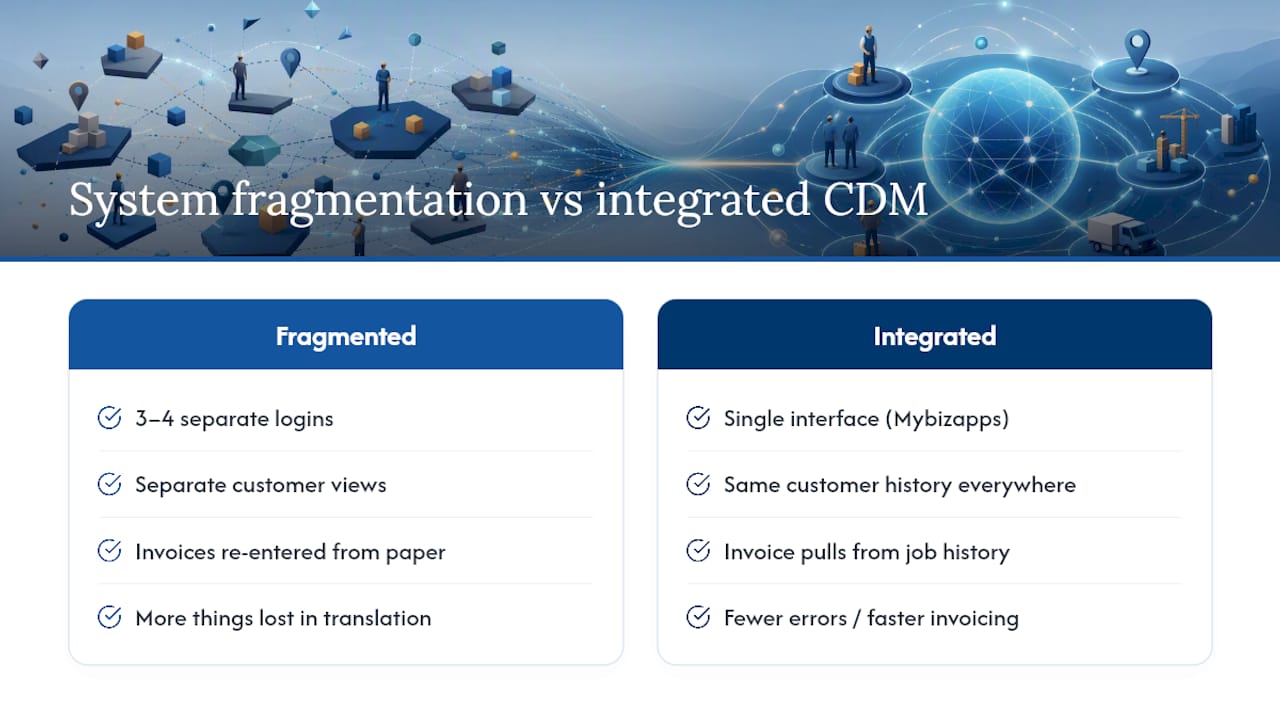
For service companies and contractors, the fragmentation problem often isn’t a data warehouse issue, it’s that customer records, quotes, invoices, and scheduling live in three or four separate logins. Mybizapps addresses that by combining customer management, scheduling, invoicing, and ticketing under one interface, so a technician looking at a work ticket sees the same customer history a billing clerk sees when generating an invoice.
Such a single-record approach can lead to faster invoicing and improved cash flow: when the invoice pulls directly from a job’s history instead of getting re-entered from a paper ticket, fewer things get lost in translation. For a small business trying to keep quotes, jobs, and payments straight, that consolidation can perform the function of a dedicated MDM platform scaled to fit the size of the team running it.
Where Do Most Customer Data Projects Actually Fail?
Most CDM projects don’t fail on technology, they fail on governance nobody assigned. A team builds a clean golden record, then six months later nobody owns fixing new duplicates, and the record drifts back into the same mess it replaced.
Keep your first pilot narrow: one use case, six to twelve weeks, one measurable outcome like invoice cycle time or a data quality score. Track time-to-first-clean-golden-record as your early signal. If that number keeps slipping, the problem is almost always a missing steward, not a missing feature.
— Philip
Ready to Stop Chasing Customer Records Across Five Systems?
Certain platforms give service businesses and contractors a single login that this article has been describing: one place where customer history, quotes, invoices, scheduling, and payments all connect, instead of multiple logins that never quite agree with each other. Where a dedicated MDM platform solves fragmentation for enterprise data teams, some platforms solve the same core problem for smaller teams, without the implementation timeline or the price tag.

If your invoices are pulled from memory instead of a job’s real history, that’s the fragmentation this whole guide has been about, and it’s the first thing an integrated platform fixes. Check the current plans and pricing to see what fits your team’s size, or look over the full feature breakdown before you commit to anything. Either way, the next step is a five-minute look at your price sheet, not another spreadsheet cleanup project.
Where to Learn More About CDM and Data Governance
For deeper technical detail, Oracle’s CDM overview covers enterprise-grade capabilities, Semarchy’s MDM guide explains golden record practices, and Stibo Systems’ golden record guide covers governance frameworks in more depth. For readers weighing a custom data build against a packaged tool, Vetros offers useful background on data product patterns.
Sources
- Customer data management — definition, benefits, and best practices
- 5 Best Practices for Customer Master Data Management (MDM)
- Overview of Customer Data Management - Oracle Help Center
- A quick guide to golden customer records in MDM
- 12 Customer Record Management Tips and Tools
FAQ
What Is the Difference Between CDM and CRM?
CRM (customer relationship management) is typically the software your sales and service teams use daily. CDM is the broader discipline of collecting, cleaning, and governing that data across every system, CRM included, so it stays trustworthy everywhere it’s used.
What Is a Golden Record?
A golden record is the single, verified version of a customer’s data built by consolidating, deduplicating, and enriching information from multiple source systems. It’s the end goal of most MDM work, and it’s what lets every department trust the same customer profile.
How Long Does a Customer Data Management Project Take?
A focused pilot on one use case, like billing accuracy, typically runs six to twelve weeks before you have enough results to justify scaling further. Full-platform rollouts take longer and depend heavily on how many source systems you’re consolidating.
Does Mybizapps Handle Customer Data Management for Small Businesses?
Mybizapps consolidates customer records, quotes, invoices, and scheduling under a single login, which addresses the fragmentation that causes most small-business data problems. Current plan details and pricing are listed on the Mybizapps price sheet.
What’s the Biggest Mistake in Customer Data Management?
Skipping governance is the most common failure point: teams clean their data once, then have nobody assigned to keep it clean. Preventing bad data at entry, through validation rules and required fields, is consistently cheaper than cleaning it up later.