Contractors: 3 Habits That Stop Most Estimate vs Quote Disputes
Contractors: 3 Habits That Stop Most Estimate vs Quote Disputes
A quote locks in a fixed price the moment your client accepts it. An estimate doesn’t. That’s the whole distinction, and mixing the two up is how contractors end up eating costs or arguing with a client who thought a number was final. Send an estimate when you’re still scoping the job. Send a quote once materials, labor, and site conditions are locked, and label every document so there’s no confusion about which one you sent.
TL;DR:
- An estimate is a non-binding range based on incomplete information, while a quote is a fixed, detailed price tied to a confirmed scope of work.
- Use estimates when site inspection or material confirmation is incomplete, and provide quotes once details are finalized and confirmed.
- Every estimate should clearly state assumptions, excluded costs, validity period, and a range, whereas quotes require itemized pricing, scope, payment terms, and an expiry date.
- Label documents accurately as estimates or quotes, include an expiry date, and obtain signatures to reduce legal disputes.
- Centralized software systems improve accuracy, speed up invoicing, and help prevent scope creep by linking estimates, quotes, and invoices in one record.
Table of Contents
- Estimate vs Quote: What Each Term Actually Means
- When Should You Send an Estimate Instead of a Quote?
- What Belongs in an Estimate vs a Quote
- How to Price Estimates and Quotes Without Losing Money
- Turning an Estimate Into a Firm Quote
- Why Labeling and Documentation Matter Legally
- Operationalizing Estimates and Quotes With Software
- Three Habits That Prevent Most Pricing Disputes
- Manage Estimates, Quotes, and Invoices in One Place
- Sources
Estimate vs Quote: What Each Term Actually Means
Contractors throw around “estimate,” “quote,” “bid,” and “proposal” like they’re interchangeable. They aren’t, and the fuzziness is exactly what causes billing fights six weeks into a job.
An estimate is an educated guess. It’s a range built on the information you have at the time, usually before you’ve measured every wall or confirmed material costs with your supplier. FreshBooks describes it as a non-binding approximation that can shift as details firm up, and that flexibility is the point. You’re not promising a number. You’re giving a client enough information to decide whether to move forward.
A quote is different. It’s a fixed price tied to a specific, itemized scope of work. Once a client signs off on it, it becomes a binding offer, which means you can’t quietly raise the price later because lumber costs went up or the job took longer than you thought. That risk sits with you, not the client, unless you’ve built a change-order clause into the document (more on that below).
Bids and proposals are cousins of the quote, not synonyms for it. A bid usually shows up in competitive situations, like a commercial contract where multiple contractors submit pricing and the client picks one. A proposal goes further than a quote by including your approach, your qualifications, and sometimes a project timeline, on top of the price. In residential work, most of what people call a “bid” is really a quote wearing a different hat.
Where this matters most:
- Landscaping and handyman work: estimates are common and often free, since the scope is simple enough to eyeball.
- Renovation and construction: quotes dominate because material and labor costs need to be locked before anyone signs a contract.
- Commercial and government contracts: bids and formal proposals replace quotes entirely, with strict submission rules.
When Should You Send an Estimate Instead of a Quote?
The decision usually comes down to one question: do you actually know what this job requires yet?
If you haven’t seen the site, haven’t confirmed material specs, or the client is still deciding between three different scopes of work, you’re not ready to quote. Send an estimate. If you’ve walked the property, measured the space, and the client has told you exactly what fixtures or materials they want, you can quote with confidence.
Here’s a quick framework for making that call on the spot:
- Has someone physically inspected the job site? No site visit means no fixed price. Give a range instead.
- Are materials and specs confirmed? If the client is still shopping for tile or hasn’t picked a paint sheen, you’re estimating, not quoting.
- Does the client need the number for internal approval or financing? Banks and property managers often require a firm quote before releasing funds, so don’t hand them a range they can’t act on.
- Is this a repeat client with a known property? Familiar jobs with predictable scope let you skip straight to a quote more often.
A kitchen remodel almost always starts as an estimate, since demo can reveal plumbing or electrical issues nobody could see beforehand. A fence installation on a flat, measured lot can usually go straight to a quote, because there’s little that will surprise you once you’ve walked the property.
Pro Tip: Ask every new client one question before you write anything: “Do you need this number to make a decision, or to write a check?” If it’s the second one, you’d better be quoting, not estimating.
What Belongs in an Estimate vs a Quote
Vague documents are where disputes start. Both estimates and quotes need specific components, and skipping any of them is how a $4,000 job turns into a $6,500 argument.
Every estimate should include:
- A clear label at the top: “Estimate,” not “Quote,” not “Proposal.”
- A range or best/worst case number instead of one flat figure, since presenting a spread sets realistic expectations before final costs are known.
- Explicit assumptions (“assumes standard-grade fixtures, not custom tile”).
- What’s excluded (permits, disposal fees, unforeseen structural repairs).
- A validity period, even if it’s informal (“valid for 30 days”).
- An approximate timeline so the client can plan around it.
Every quote should include:
- A clear label: “Quote.”
- Itemized pricing, broken down by labor, materials, and any subcontracted work.
- Detailed scope, spelled out well enough that neither party can argue about what’s included later.
- Exclusions, stated plainly.
- Payment terms (deposit amount, milestone payments, final balance).
- An expiry date, since material costs change and you don’t want a client accepting a six-month-old price.
- An acceptance method, whether that’s a signature, a deposit, or a digital approval.
- A change-order clause explaining how and when the price can adjust after signing.
One New Zealand consumer-protection agency found that final construction prices typically land within roughly 10 to 15 percent of the original estimate in disputed cases they reviewed, which tells you something important: clients tolerate a modest gap between estimate and final cost, but anything wider needs a documented reason. That’s exactly what your assumptions and exclusions sections are for.
Allowances deserve their own line item, not a buried mention. If you’re budgeting $50 per square foot for tile but the client hasn’t picked one yet, write “$50/sq ft tile allowance, subject to change based on selection” directly on the document. Hidden assumptions are what turn a reasonable estimate into a client’s complaint about being misled.
How to Price Estimates and Quotes Without Losing Money
Numbers on paper feel objective. They aren’t. How you present a price shapes how a client reacts to changes later, and getting that presentation wrong is a common way contractors lose margin.
A single flat number invites an argument the moment costs shift. A range does the opposite: it primes the client to expect movement, so when the final invoice lands at the high end, nobody’s surprised. Say “$8,000 to $9,500” instead of “$8,750” whenever the job has real unknowns, like demo work that could reveal hidden damage.
Contingencies protect your margin on the jobs that go sideways. A reasonable rule of thumb for most remodel and repair work is to build in 10 to 15 percent above your best estimate of materials and labor, higher if you’re opening up walls or working on a property older than 30 years where surprises are common. Treat that contingency as real money, not padding. It’s what keeps a plumbing surprise from turning a profitable job into a break-even one.
The mistakes that quietly drain margin:
- Quoting off a phone call instead of a site visit, then eating the gap when reality doesn’t match the description.
- Forgetting to price disposal, permits, or delivery fees because they felt like an afterthought.
- Copy-pasting last year’s material costs into a new quote without checking current supplier pricing.
- Leaving out a change-order clause, so scope creep becomes free labor.
Pro Tip: Keep a running note of every job where your final cost beat your estimate by more than 15 percent. After five or six of these, you’ll usually spot the same missed line item every time, and that’s the one to fix in your template.
Turning an Estimate Into a Firm Quote
Converting a rough number into a fixed price isn’t guesswork. It’s a short, repeatable process.
- Do the site visit. Measure, photograph, and note anything that could complicate the job, like old wiring, uneven flooring, or limited access for equipment.
- Confirm specs with the client. Get exact answers on materials, finishes, and any features that were left open in the estimate. Quotes typically require this deeper inspection that a fast estimate skips.
- Convert assumptions into line items. Where your estimate said “standard fixtures,” your quote should now say the exact model and cost.
- Price it out completely, including materials, labor, permits, and your contingency buffer.
- Present it with an expiry date and an acceptance method, then get a signature or deposit before scheduling any work.
Change orders keep this process honest once the job starts. If the client wants an upgrade or you hit an unexpected issue mid-project, write it up as a separate document: what changed, the added cost, and a spot for the client to approve it before you proceed. Verbal “yeah, go ahead” approvals are how contractors end up doing free work.
Why Labeling and Documentation Matter Legally
None of this is legal advice, but a few practical habits make a real difference if a pricing dispute ever lands in front of a judge or a small-claims mediator.
Label your documents. Just write the word “Estimate” or “Quote” at the top of the page. It sounds almost too simple to matter, but that single label establishes the document’s intent and becomes real evidence if a client later claims they thought a range was a fixed price.
Courts and mediators generally treat an accepted, signed quote as a contract. An unsigned estimate carries far less weight, especially when it’s clearly marked as non-binding and includes stated assumptions.
Expiry dates matter for the same reason. A quote with no expiration can come back to bite you months later when material costs have moved but the client insists on the old number. Get signatures or documented digital acceptance on every quote, and for larger jobs, encourage clients to review payment terms carefully. If a dispute involves real money, that’s the moment to point them, and yourself, toward an attorney rather than trying to settle it over text messages.
Operationalizing Estimates and Quotes With Software
Checklists only work if someone actually follows them on every job, and that’s where most manual systems break down. A contractor juggling spreadsheets, texts, and paper quotes eventually skips a step, usually the expiry date or the change-order clause, and that’s the job that turns into a dispute.
An integrated platform closes that gap by linking documents instead of leaving them scattered. When an estimate turns into an approved quote, that same record flows into invoicing, without anyone retyping line items or losing track of what the client actually signed off on. A few practical benefits show up fast:
- Estimates and quotes live in one system instead of three different apps or a stack of paper.
- Accepted quotes convert directly into invoices, so nothing gets re-entered or missed.
- Acceptance records and signatures stay attached to the job, which matters if a question comes up later.
- Scheduling and dispatch connect to the same record, so field staff work from the same numbers office staff quoted.
Businesses using centralized systems like this commonly report faster invoicing and improved cash flow, since there’s no lag between a signed quote and a bill going out the door. The gap between quoting and getting paid is where a lot of small businesses quietly lose money, and it’s usually a process problem, not a pricing problem.
Three Habits That Prevent Most Pricing Disputes
Most pricing disputes trace back to the same three failures: no label on the document, no written assumptions, and no expiry date. Fix those three things and you’ll eliminate the majority of “but you told me it would cost X” conversations before they start.
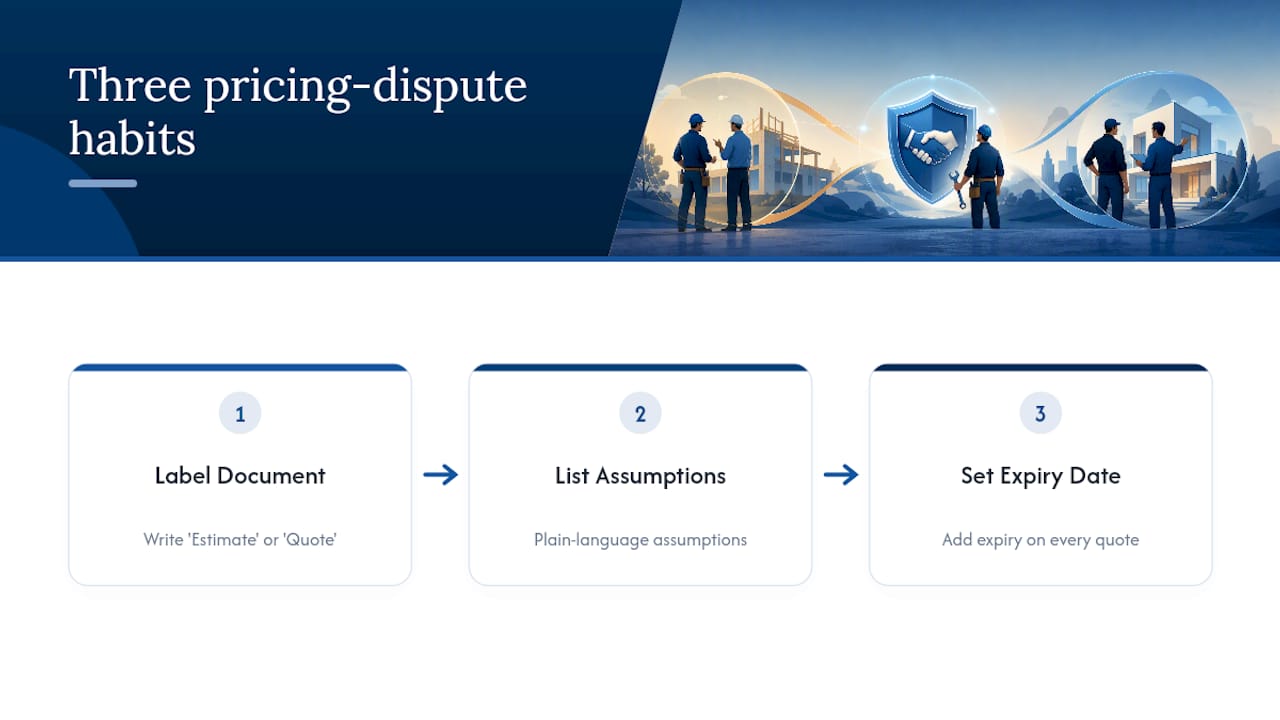
Label everything. Write “Estimate” or “Quote” at the top, every time, no exceptions. List your assumptions in plain language a non-contractor can understand, because “standard fixtures” means nothing to a homeowner who’s never bought a faucet. And put an expiry date on every quote, even a rough one, so a six-month-old price never comes back to haunt you.
Sales staff and field crews need to talk to each other before a document goes out. I’ve seen the same failure pattern repeatedly: a salesperson quotes a job sight unseen, the crew shows up, and the actual scope is nothing like what was priced. One roofing contractor I came across handled this by requiring a photo-documented site visit before any quote left the office, no exceptions, even for repeat clients. Disputes on that crew’s jobs dropped noticeably once that single rule took hold. It cost them a little speed on the front end and saved them arguments on the back end, which is almost always the better trade.
— Philip
Manage Estimates, Quotes, and Invoices in One Place
Chasing a signed quote through a text thread, then re-typing it into invoicing software, then hunting for the acceptance record when a client questions the bill, that’s the exact workflow this article just told you to avoid. An integrated platform can keep estimates, quotes, scheduling, and invoicing under one login, so the document a client signs is the same record that generates the invoice, with no retyping and no missing paperwork.

That matters most on the jobs where scope shifts mid-project. A change order gets logged against the same job record instead of living in a separate email nobody can find later. Field crews see the same quoted scope the office sent, so nobody shows up pricing one job and building another. Check the Mybizapps price sheet to see how estimates, quotes, and invoicing map to your current pricing tiers, or review the full pricing plans to find the right fit for your team size.
Sources
A few sources worth bookmarking if you want to dig deeper into how these documents work in practice:
- Quote, Estimate, Bid, or Proposal? The Differences Explained | FreshBooks Blog - FreshBooks
- Quote vs. Estimate: What’s the Difference? | Bench Accounting
- Cost estimate — Wikipedia