Service Pricing Strategies for Small Firms: Price Floor and Pilot
Service Pricing Strategies for Small Firms: Price Floor and Pilot
Start by calculating your price floor, then pick a model that captures the value you actually deliver. Cost-plus works for simple, repeatable jobs. Value-based or tiered pricing earns more for differentiated work. Map your customers by willingness to pay, pilot one change with shadow billing, and track win rate and margin before rolling it out everywhere.
TL;DR:
- Using shadow billing to compare new value-based or fixed prices against current hourly quotes helps ensure profitability before a full rollout.
- Building three-tier packages with a desirable middle option and a less attractive decoy can increase average client spend without lowering margins.
- Testing pricing changes on new leads for at least 30 to 60 days provides reliable data on impact to win rates, deal size, and margins, avoiding damage to existing relationships.
- Accurately calculating your true price floor requires consolidating data on labor costs, utilization rates, job history, and receivables within a single system.
- Raising prices and accepting some client attrition are normal, as long as you have tested your new rates and targeted new clients with pilot programs first.
Table of Contents
- The Five Common Service Pricing Strategies (And When Each One Backfires)
- Service Pricing Models: Matching the Structure to the Work
- How to Choose a Pricing Strategy That Fits Your Business
- Pricing Tactics That Move the Average Deal Without Cutting Margin
- Testing and Measuring Whether a Price Change Actually Works
- Running the Numbers: What Pricing Actually Requires Behind the Scenes
- What I’d Actually Prioritize If I Were Setting Prices Tomorrow
- Where to Read More on Service Pricing
- Sources
The Five Common Service Pricing Strategies (And When Each One Backfires)
Every service business ends up using some version of five strategies. Knowing which one you’re actually running, on purpose, changes everything.
Cost-plus pricing takes your cost to deliver a job and adds a fixed markup. A cleaning company that spends labor and supplies on a job and adds a markup charges accordingly. It’s simple and defensible, but it caps your upside. If you get faster or better than competitors, cost-plus pricing punishes you for it because your price stays tied to your cost, not your results.
Competitive pricing sets rates by matching or undercutting what similar providers charge. This works fine in commodity categories like lawn care or basic IT support, where buyers comparison shop. The trap is obvious once you see it: chasing competitors’ prices with no floor of your own is how margin erosion happens. You end up racing toward whatever the cheapest, often worst, provider in your market charges.
Price skimming means launching high and lowering later. It fits services with limited capacity or a genuine novelty, like a consultant introducing a new certification-backed method before competitors offer it. Skimming works only while the differentiation is real and visible to buyers.
Penetration pricing does the opposite: enter low to build a client base fast, then raise prices once you’ve proven the work. This suits new service lines with room to scale, like a bookkeeping firm entering a new industry vertical. The danger is training your first clients to expect the discount rate forever.
Value-based pricing ties your price to the outcome or savings you create for the client rather than your time or cost. B2B service firms that build value elements into pricing tend to report meaningfully higher margins than cost-based competitors, because price scales with impact instead of hours logged. It requires more upfront work, mainly interviews to understand what a result is actually worth to the buyer, but it’s the strategy with the highest ceiling for differentiated services.
- Cost-plus: best for standardized, repeatable jobs with predictable costs
- Competitive: workable in commodity markets, risky without a firm price floor
- Skimming: fits limited-capacity launches or genuine first-mover advantage
- Penetration: good for new service lines, risky if you never raise rates later
- Value-based: highest margin potential, requires real customer research
Service Pricing Models: Matching the Structure to the Work
The strategy you choose determines what you charge for. The pricing model determines how you bill it. These are different decisions, and mixing them up is where a lot of service businesses lose money.
- Hourly billing rewards time spent, not results delivered. It’s easy to set up and explain, but it actively punishes efficiency: the faster and better you get, the less you earn per job. It works best for unpredictable, scope-fluid work like emergency repairs or legal consultations where the hours genuinely vary.
- Fixed or project fees quote a flat rate for defined deliverables. This protects your margin if you scope tightly, and it lets clients budget with certainty. It fails fast when scope creep sneaks in, so you need a written change-order process before you quote a single fixed-fee project.
- Retainers and subscriptions bill a recurring flat fee for ongoing access or a bundle of services, common in marketing, IT support, and accounting. They stabilize cash flow and make revenue predictable, but only if you cap deliverables clearly. Unlimited retainers without limits are a slow leak on your margin.
- Tiered packages offer good, better, best options at different price points. Landscapers, cleaning services, and consultants all use this to let clients self-select their spend level without a custom quote every time.
- Outcome or value-based fees tie payment to a measurable result, like a percentage of savings a consultant generates or a bonus tied to a launch date. According to TSIA’s guidance on professional services pricing, outcome-based pricing scales well only when the result is genuinely measurable and high-value; otherwise it becomes a negotiation nightmare.
If you’re moving off hourly billing, run shadow billing first. Track hours on real jobs for a month while quoting fixed or value-based prices on paper, and compare the two numbers before you commit.
How to Choose a Pricing Strategy That Fits Your Business
The right pricing strategy comes from three inputs: your true costs, what different customer segments will actually pay, and what you’re trying to accomplish this year. Skip any one of the three and you’re guessing.
Start with your price floor. Add up your total annual costs, including your own salary, overhead, insurance, and software, then divide by your realistic billable hours, not your theoretical maximum. Most service providers can only bill 60 to 70% of a working year once you account for admin time, sales calls, and no-shows. StartCosts’ worked examples show how skipping this step is the single most common reason small service businesses stay unprofitable while staying busy.
Once you know your floor, segment your clients by willingness to pay. A client who calls you because a competitor failed them will usually pay more than one who’s comparison shopping three quotes. Interview a handful of past clients directly and ask what the job was actually worth to them, not what they expected to pay.
Then design a pilot before you change pricing company-wide.
- Pick one service line or one new client cohort to test the new price or model
- Run it for at least 30 to 60 days or a minimum of 8 to 10 quotes
- Track win rate, average deal size, and margin against your current baseline
- Only roll out broadly once the pilot beats your baseline on at least two of those three metrics
Pro Tip: Run your pilot on new leads, not existing clients. Testing a price increase on people who already trust you skews the result, because loyalty, not pricing psychology, is doing the work.
Pricing Tactics That Move the Average Deal Without Cutting Margin
Once your floor and model are set, a handful of tested tactics change what clients choose without changing what you’re worth.
Anchoring with a three-tier offer is the most reliable one. Present good, better, best packages, and most buyers gravitate toward the middle option once a higher anchor exists above it. A cleaning company offering Basic, Standard, and Premium tiers will typically sell more Standard packages than if Standard were the only option on the page.
Decoy tiers work by making one option deliberately less attractive so it pushes buyers toward your preferred tier. If your middle package is priced close to your top package but offers noticeably less, most buyers step up rather than settle.
Bundling combines services that are worth more together than separately, like pairing a consulting audit with a follow-up implementation package at a bundled rate.
BCG’s research on pricing strategy points to well-differentiated three-tier packaging as a reliable lever for increasing what buyers choose to spend, and internal pricing analysis has found three-tier structures lifting average deal size by 12 to 18% in subscription and software contexts.
- Build your middle tier as the one you actually want most clients to pick
- Make the decoy tier close in price but clearly thinner in value
- Bundle complementary services rather than unrelated ones
On price endings: dropping a price to $99 instead of $100 shows measurable effects in retail, but Kellogg research on price endings found the effect matters most for low-consideration purchases. For a $4,000 consulting retainer, a client isn’t fooled by $3,997 versus $4,000, and trying it can read as gimmicky in a B2B relationship.
Testing and Measuring Whether a Price Change Actually Works
Never flip pricing for your whole client base overnight. A structured test tells you whether the new number holds up before it costs you real clients.
- Shadow bill first. Keep quoting and invoicing at your current rates, but calculate what the job would have cost under the new pricing model in parallel. This shows you the gap without touching a single client relationship.
- Run a live A/B split on new leads. Quote half your new inquiries under the old structure and half under the new one for a defined window, then compare which converts better and at what margin.
- Track four numbers, not one. Proposal win rate tells you if the price is scaring off buyers. Average deal size tells you if the new model is capturing more value. Gross margin tells you if it’s actually more profitable once costs are counted. Discount depth tells you how much your team is quietly giving away to close deals.
- Set a decision threshold before you start. Decide in advance what a win looks like, for example margin up by at least 5 points with win rate flat or better, so you’re not rationalizing a bad result after the fact.
Stripe’s guidance on building and testing pricing frames this as an iterative loop, not a one-time decision: know your audience, study competitors, understand your costs, test, and adjust again. Pricing isn’t something you set once a year and forget.
Running the Numbers: What Pricing Actually Requires Behind the Scenes
A pricing strategy is only as good as the data behind it. Most service businesses that struggle to price confidently aren’t missing a strategy, they’re missing the numbers.
To price with any confidence, you need to know: labor cost per employee including taxes and benefits, real utilization rate (billable hours versus hours actually worked), job history by service type so you can see what similar work actually costs to deliver, and days sales outstanding so pricing changes don’t get undone by slow collections.
Scattered spreadsheets and disconnected apps make this data hard to trust. When quotes live in one tool, invoices in another, and scheduling in a third, nobody has a clean picture of true job cost or utilization, and pricing tests take weeks to evaluate instead of days.
Consolidating that workflow into a single system removes the friction. When quoting, invoicing, scheduling, and job history sit under one login, a price change in a quote template shows up in the invoice and the job cost report without re-entering anything, and centralized job history speeds up willingness-to-pay estimates because you can see what similar jobs actually closed at. Mybizapps builds toward exactly this kind of setup for contractors and small service teams, with quotes, scheduling, and accounting under a single mobile-first login rather than five separate tools.
- Labor cost per employee, fully loaded with taxes and benefits
- Real utilization rate, not theoretical billable capacity
- Job history segmented by service type
- Days sales outstanding, tracked monthly
What I’d Actually Prioritize If I Were Setting Prices Tomorrow
Most service owners obsess over what to charge and ignore the harder question: what utilization rate are you willing to accept to charge it. Raise prices and some clients leave. That’s not failure, it’s the strategy working as intended, because the clients who stay are the ones who valued the work at your new number.
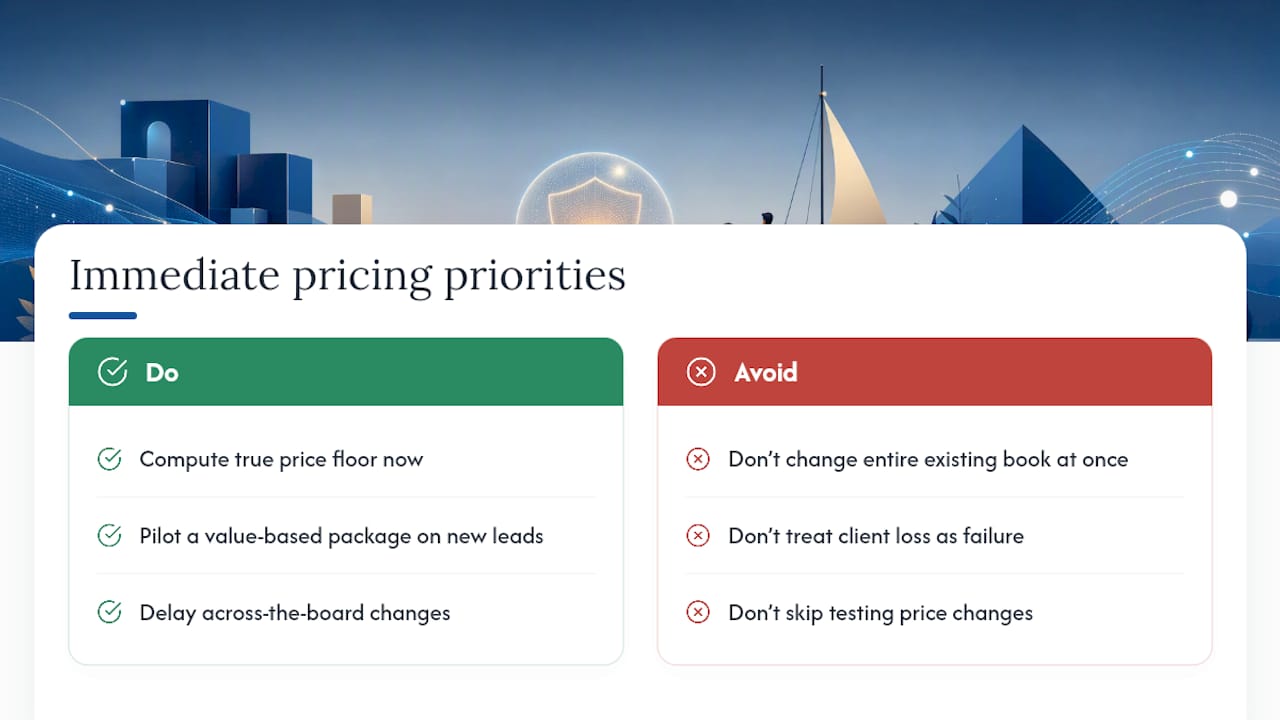
If you do nothing else this quarter, compute your true price floor using real billable hours, then pilot one value-based package on new leads only. Don’t touch your entire existing book at once.
Expect pushback from a handful of long-term clients when you eventually raise rates across the board. That’s normal, not a sign you got the number wrong. The businesses that struggle with pricing aren’t the ones who lose a few price-sensitive clients. They’re the ones who never tested a change at all and quietly underpriced themselves for years instead.
— Philip
Where to Read More on Service Pricing
For deeper reading on the ideas covered here: Esade’s overview of pricing methods covers value-based pricing and willingness-to-pay research in more depth. Stripe’s pricing strategy guide walks through the full testing and iteration loop. TSIA’s professional services pricing guide breaks down model selection by service type. StartCosts’ small business pricing guide offers worked price-floor formulas. BCG’s pricing strategy resource covers behavioral tactics like anchoring and decoys.
Sources
- Pricing methods (Esade)
- Pricing strategy (BCG)
- How to Price Your Services: Small Business Guide
- Professional Services Pricing Done Right Full Guide | TSIA