Quote Follow Up: A 14-Day Plan That Wins More Jobs
Quote Follow Up: A 14-Day Plan That Wins More Jobs

The best quote follow up is a short, scheduled series of useful touches: a message on day 2, a call on day 5, a message with something new on day 9 and a final call on day 14. Each one gives the customer a reason to answer, such as a date, a detail or a question. The quote also carries a clear expiration date, and you stop when the customer answers or the sequence ends. Most lost quotes are not rejected. They go quiet because nobody had a system for the next step. The rest of this guide gives you the schedule, the wording, the rules on validity and expiration, and a way to run it without relying on memory.
TL;DR
- Send the quote with a total, what is included, how to accept it and an explicit “valid through” date, then follow up on a fixed schedule instead of when you remember.
- A workable cadence: a message about 2 days after sending, a call around day 5, a message with something new around day 9, and a final call near day 14.
- Every touch needs a reason that helps the customer: a question answered, a date approaching, a scheduling slot, a clarified scope.
- Most service businesses set validity at 14 to 30 days. Never leave the date off, and answer a request to extend with a fresh, dated quote.
- Stop on any reply, win or loss. After the last call, park the quote with a date to return, and move on.
Table of Contents
- Why quotes go quiet
- Start before you follow up: build a quote that is easy to say yes to
- The 14-day quote follow-up schedule
- How often is too often?
- Write follow-ups that sound human
- How long should a quote stay valid?
- What your quote expiration policy should say
- What to do when the customer never replies
- Make follow-up a system, not a memory test
- Perspective
- Turn approved quotes into booked, billed work
- A quick checklist to keep next to your desk
- FAQ
- Sources
Why quotes go quiet
A quote lands in an inbox next to a dozen other things. The customer may be comparing two or three bids, waiting on a spouse or a budget approver, or simply busy. Silence usually means “not yet,” not “no.”
The common opener, “just checking in to see if you got my quote,” fails because it asks the customer to do work and gives nothing back. It also signals that you have nothing to add. A business owner on a public forum put it bluntly: their own go-to follow-up reeked of desperation. The fix is not to follow up less. It is to make every contact worth opening.
You will often see the claim that 80% of sales need five follow-ups. Treat that as a reminder to persist rather than a law: a 2026 roundup of follow-up data traces the figure to a very small survey from 1942. What holds up better is speed and consistency. The same roundup cites a Harvard Business Review study of 2,241 US companies in which 23% never responded to a test lead at all. The bar for being the responsive contractor is low.

Start before you follow up: build a quote that is easy to say yes to
Follow-up is far easier when the quote itself is clear. Before the quote leaves your hands, check that it has:
- The total and what it covers. List inclusions, and note anything excluded so the customer does not discover it later.
- The acceptance step. Say exactly what “yes” looks like: reply “approved,” sign here, or tap a link.
- An explicit expiration date. Write a calendar date, not “30 days.” Quote template guidance recommends stating it plainly, for example “valid through July 15, 2026.”
- Your next available start date. A real slot on the calendar gives the customer a reason to decide.
The date does double duty. It protects your pricing and it gives you an honest, logistics-based reason to get in touch. One 14-day follow-up plan argues that pushiness is not about how often you contact someone but about whether each touch is for the customer, and that a valid-until date is what makes a nudge feel like service.
If the quote has to pass through several people on your side or the customer’s, the quote approval process you use matters too. A quote stuck waiting for your own sign-off is a follow-up problem you created.
The 14-day quote follow-up schedule
The cadence below follows the structure of the 14-day plan from Pembury & Stone: send the quote on day 0 with a validity date two to three weeks out, then make four contacts. Adjust the spacing to the size of the job. A $200 repair deserves a shorter runway than a $40,000 remodel.
| Day | Channel | Purpose | What to include |
|---|---|---|---|
| 0 | Email or portal | Send the quote | Total, inclusions, acceptance step, valid-through date |
| 2 | Message | Confirm receipt, offer help | A direct question about scope or timing |
| 5 | Phone call | Talk through it | Walk through the numbers, ask what they are weighing |
| 9 | Message | Add something new | A relevant photo, a similar finished job, a schedule opening |
| 14 | Phone call | Close the file | Ask for a decision or permission to park the quote |
Day 2: a light, useful message
Keep it short and make it easy to reply. Name the job, attach the quote again, and ask one question that moves things forward.
Hi Maria, I wanted to make sure the quote for your kitchen faucet and drain repair came through. I attached it again so it is easy to find. Is there anything in the scope you would like me to adjust? Our next open slot is Thursday the 21st, and the quote is valid through the 28th.
Why this works: it restates the job, removes the hunt for the attachment, asks something specific and anchors the date.
Day 5: the call
A call lets you hear what an email hides. Your goal is not to pitch again. It is to find the real obstacle. Useful questions:
- “Is there anything about the price or scope you would like me to walk through?”
- “Are you comparing a couple of options? What matters most in your decision?”
- “Who else needs to sign off, and is there anything I can send them?”
If you get voicemail, leave 20 seconds: who you are, the job, the valid-through date, and a callback number. Then send a text or email that repeats it.
Day 9: bring something new
By now a repeat of the same message is noise. Add one piece of value:
- a photo or short description of a similar job you finished recently
- an answer to a question customers commonly ask about this type of work
- a note that a scheduling window has opened or is about to close
- a clarification, such as which materials are included in the price
Hi Maria, a quick note on your repair. A similar job we did last month turned out to need a new shutoff valve, so I included one in your scope so there are no surprises. We have a slot opening Tuesday if you want to lock it in.
Only write a message like this if it is true. Do not invent urgency. A real calendar is a stronger nudge than a made-up deadline.
Day 14: the final call
Near expiry, call and be direct but kind:
“I wanted to reach out before the quote expires on the 28th. Would you like to go ahead, or would it help if I changed something? If the timing is not right, I am happy to hold a note and check back in the spring.”
This gives them three easy answers: yes, adjust it, or not now. All three are better than silence.
How often is too often?
Four contacts over two weeks is a reasonable ceiling for most service jobs. The number matters less than the quality. A second cadence lands in the same place: follow up two to four days after sending, again about a week later with one useful detail, and finally near expiry with a close-the-file note.
Some practical rules:
- Match the channel to the customer. If they answered your first email within an hour, they live in email. If they gave only a phone number, call.
- Stop on any reply. Once the customer responds, you are in a conversation, not a sequence. Pause the schedule and answer them.
- Respect opt-outs immediately. If someone says “do not text me,” stop texting. Marketing texts and automated messages are also governed by the Telephone Consumer Protection Act, so get the customer’s consent to be texted before you rely on SMS, and honor a “STOP” reply. If you are unsure how the rules apply to your situation, ask a business attorney.
- Do not stack channels the same day. An email, a text and a call within an hour reads as pressure.
Write follow-ups that sound human
Four habits separate follow-ups people answer from the ones they ignore.
Lead with the customer’s situation. “You mentioned the tenant moves in on the 1st” beats “I am following up.”
Ask one question. Two questions halve your reply rate. Choose the one that unblocks the decision.
Make the next step tiny. “Reply with a yes and I will put you on Thursday” is easier than “let me know your thoughts.”
Use the customer’s words. If they said “I need to talk to my husband,” ask when you can send something that is easy to forward.

Examples for common situations
The customer says it is higher than expected. Do not slash the price. Ask what they were expecting and offer to adjust the scope: a different material, a phased job, or a later start.
“Totally understand. Would it help if I broke this into two phases so the first part fits your budget? Here is what each phase would cover.”
The customer asks for more time. Agree on a date to talk again and write it down.
“Of course. I will check back with you on the 10th. The quote is valid through the 28th, and if it lapses I can reissue it.”
You are competing against another bid. Ask what matters beyond price: start date, warranty, communication. Then speak to those points.
How long should a quote stay valid?
There is no single legal answer for service quotes, and that is the reason to set one yourself. Many small businesses choose between 14 and 30 days, and shorten that to a week or so when material prices swing or your calendar is nearly full. Larger projects with several approvers often run 45 to 60 days. LegalClarity’s template guidance calls 30 days the most common standard and says 60-day windows are routine for larger projects with longer decision cycles.
Factors that should set your number:
| Factor | Shorter window (7 to 14 days) | Longer window (30 to 60 days) |
|---|---|---|
| Material costs | Volatile, supplier quotes expire quickly | Stable pricing |
| Calendar | Few open slots | Plenty of capacity |
| Job size | Small, quick decision | Large, several approvers |
| Customer type | Homeowner with an urgent need | Property manager or commercial buyer |
A quote without an expiration date is not a safe default. When no date is given, a court or customer may treat the offer as open for a “reasonable time,” which is vague and invites disputes. For sales of goods, the Uniform Commercial Code adds a wrinkle: a merchant’s signed written offer that promises to stay open cannot be withdrawn during the stated time, and no such assurance can bind you for more than three months. If your quotes include materials, a stated and reasonable date keeps you in control. For anything with significant legal exposure, have a local attorney review your quote terms.
What your quote expiration policy should say
Keep the policy to a few lines on the quote itself:
- The date. “This quote is valid through [date].”
- What happens after. “After this date, pricing and availability may change, and a new quote may be required.”
- What may change the price. Scope, site access or conditions that differ from what you assessed.
- How to accept. One clear action.
When a quote expires
Once the date passes, you have three choices: issue a new quote at current pricing, extend the original, or walk away. Pick the one that fits the job. If nothing has changed on your side, refreshing at the same number is fine.
When a customer asks you to hold the price
Do not say yes automatically. A clean way to answer is to offer a new quote dated today with a fresh window:
“I cannot hold the pricing open-ended, but I can send you a fresh quote dated today with a new 30-day window. If nothing has changed on my end, the numbers will be the same.”
That wording is adapted from advice on price validity and works because it is friendly, firm and fair.
When the scope has changed
A useful rule from one contractor guide: if the approved scope, access and conditions still match what you quoted, keep the price and reschedule. If any of them changed, send a revised quote. If the quote lapsed without approval, refresh it rather than treating the old number as booked.
What to do when the customer never replies
After the day-14 call, stop. The same plan that sets the schedule also sets the exit: if there is still silence, close the loop, and if the answer is no or the timing is wrong, thank the customer and let it go.
Send a short closing note:
“Hi Maria, I have not heard back, so I will assume the timing is not right and close this quote on the 28th. If things change, reply here and I will happily send a new one.”
Then park the quote with a date to return, perhaps 60 or 90 days out or at the start of the relevant season. A lost quote is not a lost customer. Some will come back when the budget frees up, and a polite close makes you the first call. If you want ready-made wording for that later outreach, the customer reactivation templates cover it.
Make follow-up a system, not a memory test
The most common reason quote follow-up fails is not bad wording. It is forgetting. You send a quote on Monday, a job runs long on Tuesday, and by Friday the customer has hired someone else.
A system needs only three things:
- A record of every quote and its status. Sent, viewed, approved, expired, parked.
- A due date for each next touch. The day-2 message and the day-5 call should exist as tasks, not intentions.
- A log of what was said. When the customer calls back in week three, you should know what you told them. A simple routine for logging customer communications keeps the whole team on the same page.
If you want to extend this with automation, a marketing automation checklist can help you decide which messages are worth automating and where a human voice still matters. The quote follow-up that closes jobs is usually the personal call on day 5, so automate the reminders and the confirmations, not the conversation.
Perspective
Most small service businesses do not lose quotes on price. They lose them in the gap between “sent” and “decided,” when nobody owns the next step. In our experience of building software for contractors and small offices, the fix is rarely a clever script. It is having the customer record, the quote, the schedule and the invoice in one place so the follow-up is a task attached to a real job, not a sticky note.
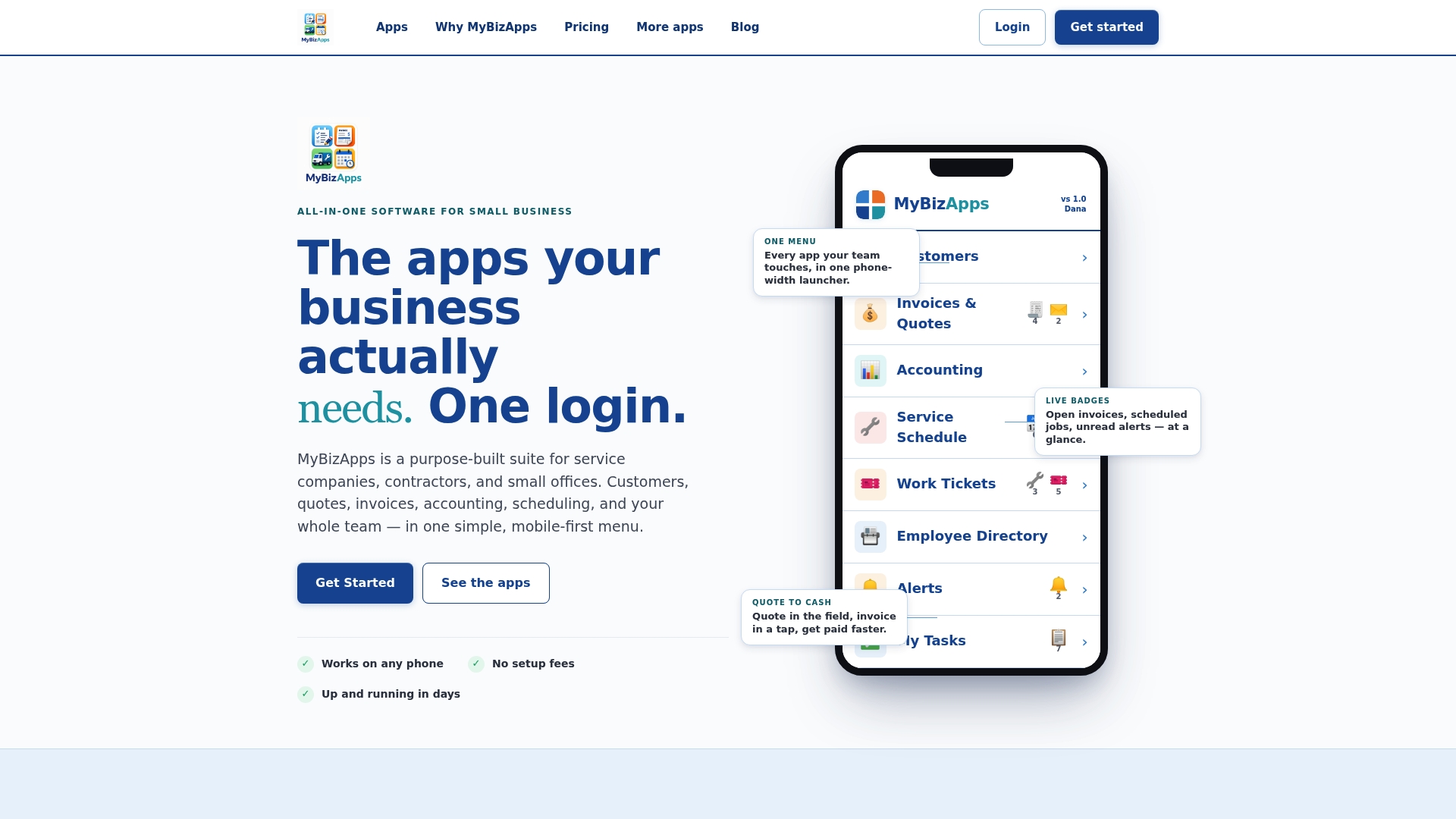
That is why we built MyBizApps as one mobile-first login: customers, quotes, invoices and scheduling sit together, so when you are on a job site you can open a customer, see the quote you sent, and know what is next. When a quote is approved, the same record carries into scheduling and billing without retyping. Our aim is simple: less time chasing, more jobs on the calendar.
Write the date on the quote. Make the next step small. Call on day 5. Stop on day 14. Then do it again for the next customer.
Philip
Turn approved quotes into booked, billed work
Follow-up ends the moment the customer says yes, and the next problem starts: getting the job on the calendar and invoiced promptly. MyBizApps brings customer management, quote and invoice creation, real-time scheduling and dispatch, accounting and credit card payment processing under one login, with team alerts and checklists so everyone knows what comes next. Modules are priced individually: the Billing Module, Service Scheduling, Accounting and Customer Portal are each $21 per month, and you add only what you need. You can see every module on the MyBizApps pricing page.
Once a quote is accepted, scheduling multiple technicians without chaos and invoicing from day one keep the cash coming in quickly. If your crew works across several jobs, the guide to contractor scheduling best practices shows how to keep the calendar honest.
A quick checklist to keep next to your desk
- Quote includes total, inclusions, acceptance step and a calendar expiration date.
- Follow-up touches are scheduled the moment the quote is sent.
- Every message has a reason: a question, a date, a slot, a new detail.
- One question per message, one clear next step.
- Replies pause the sequence.
- Opt-outs are honored immediately.
- After the final call, the quote is closed or parked with a return date.
FAQ
How soon should I follow up after sending a quote?
Two to four days is a good first window. It is long enough that you are not hovering and short enough that the job is still fresh. If the customer told you they would decide by a specific day, follow up the day after.
What is a good quote follow-up email?
A short one that restates the job, reattaches the quote, asks one specific question and mentions the valid-through date. Skip “just checking in” and open with something useful to the customer, such as an available start date or a clarified scope.
How many times should I follow up on a quote?
For most service jobs, four touches over about two weeks is enough: a message, a call, a message with something new and a final call. Stop earlier if the customer replies, accepts or declines, or asks not to be contacted.
What should a quote expiration policy say?
It should state the exact date the quote is valid through, say that pricing and availability may change afterward, and note that changes in scope or site conditions may require a revised quote. Put it on the quote itself so there is nothing to argue about later.
What should I do if a customer asks me to extend an expired quote?
Offer a fresh quote dated today with a new validity window. If nothing has changed on your end, the numbers can stay the same, and you keep control of pricing without turning the customer away.
Sources
- How to Follow Up on a Quote: 14-Day Plan, Pembury & Stone
- Follow up on quotes you already sent, CRUXIBL
- Quote Template: What Every Business Quote Needs, LegalClarity
- Price Validity in Quotations, Waco3
- Pressure Washing Quote Expiration and Weather Rescheduling, JobQuoteLab
- Sales Follow-Up Statistics 2026
- UCC § 2-205. Firm Offers, Cornell Law School