Late Fee Policy for Small Businesses: How to Write One That Holds Up
Late Fee Policy for Small Businesses: How to Write One That Holds Up

A late fee policy works when the customer agreed to it in writing before the work started, when the fee is a reasonable amount, and when your invoices state it the same way every time. Write the terms into your quote or contract, repeat them on each invoice, and apply them consistently. The rest of this guide shows what to put in the policy, how much to charge, how to word it, and how to run it without turning good customers into ex-customers. If your quotes, invoices, payments and customer records live in one place, the policy gets applied the same way every time, which is what we built our Billing Module for, at $21 per month.
TL;DR
- A late fee is only as strong as the agreement behind it: get it in writing, with a clear amount or rate, before the job starts.
- Keep the fee reasonable. Common practice is a percentage per month, often 1% to 2%, but state law sets the real limits, so check yours.
- Spell out four things: due date, grace period, fee amount, and what happens next (reminders, paused work, collections).
- Apply the policy to everyone, and decide in advance when you will waive a fee.
- Use a credit memo when an unpaid invoice needs to shrink, and a refund when money has already been paid and goes back.
Table of Contents
- What a late fee policy actually is
- Is it legal to charge a late fee on an invoice?
- What to put in your late payment policy
- Sample wording you can adapt
- Make it enforceable, and fair
- Send reminders before you charge
- When to waive a late fee
- Credit memo vs refund: what to do when an invoice changes
- Run the policy from one system
- Our view: the best late fee is the one you never charge
- FAQ
- Sources
What a late fee policy actually is
A late fee policy is the part of your payment terms that says what happens when an invoice is not paid on time. It is not a punishment, and it is not a separate document you need a lawyer to invent. For most contractors, service companies and small offices it is three or four sentences in your quote, service agreement and invoice footer.
It does two jobs. It gives customers a reason to pay on time, and it covers part of the cost you take on when they do not: the staff time spent chasing, the cash you cannot use, and the work you may have to delay. The Better Business Bureau frames it as a business-process tool, not only a penalty, and recommends setting the terms in advance and enforcing them consistently.
If you are still deciding on your payment terms in general, our guide to payment terms for contractors walks through net days, deposits and milestone billing, which come before any late fee.
Is it legal to charge a late fee on an invoice?
Yes, in general, when the customer agreed to it and the amount is reasonable. There is no single federal cap on what one business can charge another for a late invoice, so the answer depends on your contract and your state.
Two points matter most:
- The fee has to be agreed in advance. A fee that appears for the first time on an overdue invoice is hard to defend. Put it in the quote or contract the customer accepts.
- The fee has to be reasonable. According to Nolo’s attorney-written guidance, a late charge should not exceed a reasonable estimate of the actual costs the late payment causes you, and state statutes may add limits on annual interest rates.
Nolo lists the kinds of costs you can count: lost interest on the money, staff time spent pursuing payment, lost business opportunities when cash is tight, and the cost of preparing and sending the invoice. That list is useful because it tells you how to justify your number. If your fee is a small, flat or percentage amount tied to those real costs, you are on solid ground.
The BBB’s small-business guide tells owners to check their state’s official rules before choosing limits, and notes that percentage-based monthly charges of 1% to 2% are common practice but not a universal legal limit. If your fee is higher, or you serve customers in several states, ask your state’s consumer or commerce agency or a business attorney before you publish it.
What about the credit card late fee rules in the news?
Those rules cover consumer credit card issuers, not invoices between a business and its customers. The federal credit card late-fee rule that would have lowered the safe-harbor amount to $8 was vacated on April 15, 2025, so the earlier $30 and $41 safe-harbor figures applied again. None of that sets a limit for your invoice terms, so do not copy those dollar amounts as if they were your legal range.
What to put in your late payment policy
A policy that reads clearly gets followed. One that is vague gets argued. Cover these parts in this order.
1. The due date
State a specific due date or a specific number of days from the invoice date. The BBB says many businesses use a 30-day payment period, and your contract can set another. For small service jobs, shorter terms such as due on receipt or net 7 or net 14 are common, and nothing stops you from choosing them if the customer agrees.
Also say when a payment counts as paid: when the customer sends it, when you receive it, or when it clears. A card payment is received at once, but a mailed check is not. Pick one and write it down.
2. The grace period
A grace period is a set number of days after the due date during which no fee applies. It is optional, but it removes most arguments about mail delays and honest oversights. If you offer five days, say that the fee starts on day six, not that the invoice is due in 35 days.
3. The fee itself
Choose one of three models:
| Model | How it works | Best for |
|---|---|---|
| Flat fee | A fixed dollar amount once the grace period ends | Small invoices, one-time jobs |
| Monthly percentage | A percentage of the overdue balance for each month it stays unpaid | Larger invoices, repeat customers |
| Percentage with a minimum | Percentage of the balance, never less than a set amount | Mixed invoice sizes |
A worked example: a customer owes $4,000 and your terms say 1.5% per month on the overdue balance. After one month late the fee is $60. After two months it is $120, because the charge applies each month the balance stays open. Under a flat $35 fee, the same customer pays $35 once, and you may feel you have little reason to keep chasing.
Legal500’s analysis of U.S. payment clauses uses 1.5% per month, or the maximum the law allows if that is lower, as an example of a vendor-proposed term, not as a rate that is lawful everywhere. The phrase about the maximum the law allows is a good habit to copy: it keeps your clause valid if your state’s limit is lower than your rate.

4. What happens next
The BBB notes that contract terms should say how much will be charged and when, and can also state whether services may be suspended or collections pursued for nonpayment. For a contractor that might mean pausing scheduled visits on an account that is 30 days past due. Write that step in before you need it.
Sample wording you can adapt
Plain language beats legal language here. Adapt this to your own terms and have a business attorney review it if your contracts are large or you work across state lines:
Invoices are due within 14 days of the invoice date. A 5-day grace period applies. After the grace period, a late fee of 1.5% per month, or the maximum allowed by law if lower, will be added to the unpaid balance. Late fees are calculated monthly until the balance is paid in full. We may pause scheduled work on accounts more than 30 days past due.
Then repeat a short version on every invoice: the due date, the grace period, and the fee. A customer who sees the terms in the quote, the contract and the invoice cannot reasonably say they never saw them.
Make it enforceable, and fair
Legal500’s contract analysis points out what larger customers often ask for: that fees apply only to undisputed amounts, with written notice and a chance to cure before they kick in. You do not have to give every customer this, but it shows what a fair clause looks like.
Three habits make a policy hold up:
- Disclose it early. Put it in the quote the customer signs, not only in the invoice.
- Charge only on amounts that are truly overdue. If the customer disputes one line item, resolve it and keep the fee for the part that is not in question.
- Keep a record. Save the signed quote, the invoice, the date it was sent, and each reminder. If you ever need to collect, those records matter.
Send reminders before you charge
A fee should rarely be a surprise. A simple schedule works well for most service businesses:
- A friendly reminder two or three days before the due date.
- A notice the day after the due date confirming the invoice is open.
- A message when the grace period ends, stating the fee that is now being added.
- A call or letter at 30 days past due, covering the next step.
Most late payments come from forgotten invoices, not from refusal to pay. Reminders solve that, and an up-to-date invoice aging report shows you which accounts are 1 to 30, 31 to 60 or 61 or more days late, so you know whom to call first.
The better fix is to prevent lateness in the first place. Sending the invoice on the day the job is finished and making it easy to pay by card gets money in sooner than any fee will. We cover that in day one invoicing to reduce late payments, and the habits in how to get invoices paid faster apply to any small business that wants a repeatable system for overdue invoices. For larger jobs, deposit rules for service jobs cut the amount that can ever go late.
When to waive a late fee
The BBB recommends consistent enforcement but says a business may reasonably waive a fee or arrange a payment plan where circumstances warrant. The danger is waiving fees informally, so that customers learn the policy is optional.
Decide your waiver rules once:
- First-time lateness from a good customer: waive once, in writing, and say it is a one-time courtesy.
- Your own error: if the invoice was wrong, late or sent to the wrong person, waive the fee and fix the invoice.
- Hardship: offer a payment plan with dates and amounts, and note that the fee resumes if the plan is missed.
- Repeat lateness: apply the fee, and consider shorter terms or a deposit for that customer.
Tell the customer the waiver is an exception. A short note such as, we have waived this month’s late fee as a one-time courtesy, keeps the policy intact.
Credit memo vs refund: what to do when an invoice changes
Late fees often lead to a second question: what if the customer was charged too much, the job was cancelled, or a fee needs to be reversed? The two tools are a credit memo (also called a credit note) and a refund.
- A credit memo is a document that reduces the amount a customer owes. No cash moves. Use it when the invoice is still unpaid, or when the customer wants credit toward a future job.
- A refund returns money the customer has already paid, to their bank account or card.
Both can be used together: the credit memo documents the adjustment, and the refund sends back the cash.
A quick example: you send a $1,500 invoice, then agree to take $300 off for a rescheduled visit. The invoice is unpaid, so you issue a $300 credit memo linked to it and the customer owes $1,200. If they had already paid the full $1,500, you would issue the credit memo to record the change and refund the $300 to the card they used, or apply it as credit to their next job if they prefer.
If you waive a late fee on an invoice that is still open, a credit memo against that fee is the clean way to show it. If the customer already paid the fee, refund it or credit it, and record which one you did. Link each credit memo to the original invoice and apply it promptly so your books and your customer’s balance match.

Run the policy from one system
Most late-fee trouble comes from scattered tools: quotes in one place, invoices in another, payments in a third, and customer notes in someone’s head. The quote the customer accepted is hard to find when you need it, and the fee gets forgotten or applied unevenly.
We offer an all-in-one suite for service companies, contractors and small offices: customer records, quotes, invoices, accounting, scheduling and credit card payment processing under a single mobile-first login. Our Billing Module and our Accounting module are each $21 per month, and the Customer Portal is also $21 per month. See the current list on the pricing page.
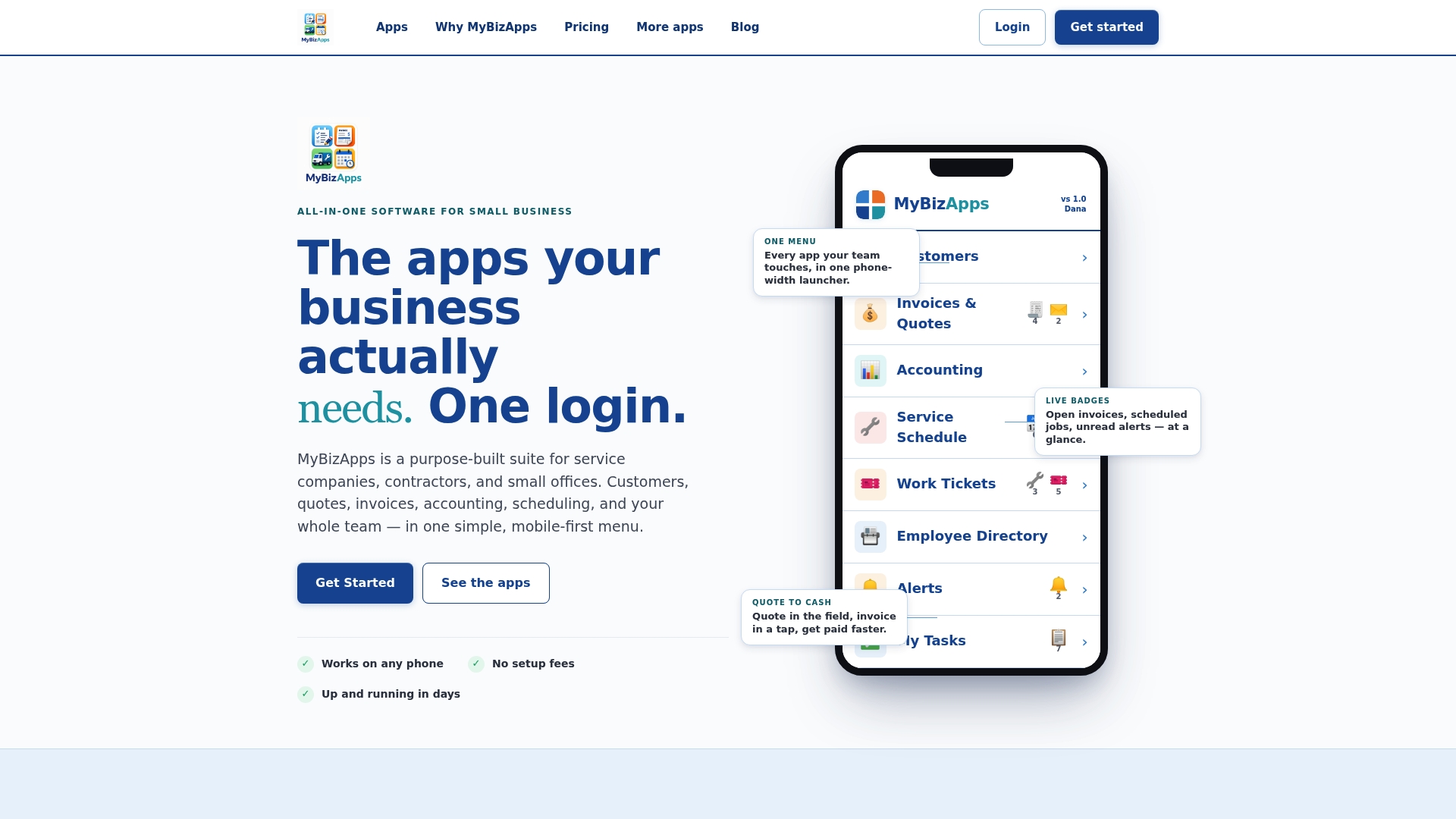
What that means for a late fee policy is practical. The customer, the signed quote and the invoice sit in one place, so you can see what was agreed and when the invoice went out. To see how invoicing connects to cash flow, read how to improve cash flow with better invoicing. If you are deciding when income counts in your books, cash vs accrual accounting explains how that choice affects what you report as overdue.
Our view: the best late fee is the one you never charge
We build software for people who run trucks, shops and small offices, and the same pattern shows up in how small businesses think about late fees: they treat them as the plan, when they should be the backstop.
A policy does its best work when it is short, written down before the job, and visible on every document the customer sees. After that, speed matters more than the fee. An invoice that goes out the day the work is done, with a clear due date and an easy way to pay by card, tends to be paid sooner than one that waits a week in someone’s inbox.
That is why we put customers, quotes, invoices, accounting and payments under one login. When your team can open a customer record on a phone and see the quote, the invoice and the payment status together, enforcing a policy stops being a chore. You apply the same terms to everyone because everything is in front of you.
Our advice: write four sentences, put them in every quote, and run your billing from one place.
Philip
FAQ
How much can you legally charge for a late fee?
There is no one federal number for business invoices. The fee must be agreed in advance and be a reasonable estimate of the costs the late payment causes you, and your state may limit annual interest rates. Common practice is a monthly percentage, often 1% to 2%, but check your state’s rules before you set yours.
Is a 10% late fee legal?
It depends on your state and your contract. A fee that is far above the cost the late payment causes you is the kind that can be challenged as unreasonable, and 10% charged monthly would be an annual rate well above common practice. A smaller percentage or a flat fee tied to your real costs is safer.
Will I get a late fee if I pay on the due date?
No, not if your terms are written clearly. A payment made by the due date is on time, and if you offer a grace period, the fee starts only after it ends. Your terms should also say whether payment counts when sent, received or cleared.
Can I add a late fee that was not in the original agreement?
It is risky. A fee the customer never saw or agreed to is hard to enforce. Add the policy to your quotes and contracts going forward, and apply it to new work.
Should I issue a credit memo or a refund?
Issue a credit memo when an invoice is unpaid and needs to be reduced, or when the customer wants credit toward future work. Issue a refund when the customer has already paid and you are returning the money. Use both together when you need a record of the change and the cash goes back.
Sources
- BBB: How to set and enforce late payment penalties
- Nolo: When can I charge late fees or finance charges?
- Legal500: Payment Clauses in U.S. contracts
- America’s Credit Unions: Nullified and Vacated
- How to get invoices paid faster