How to Improve Cash Flow With Better Invoicing
How to Improve Cash Flow With Better Invoicing

You improve cash flow through invoicing by shortening the gap between finishing a job and having the money in your account. Four things close that gap: invoice the day the work is done, put clear terms on every invoice, make paying take one tap, and follow up the day a payment is late. Each fix is small. Together they can change how many weeks of expenses you can cover.
This guide is written for contractors, service companies and small offices that send their own invoices. It covers the habits that matter, a worked example, and what to do when faster invoicing is not enough.
TL;DR
- Send the invoice the day the job is finished, ideally from the job site, not at the end of the week.
- State terms before work starts and repeat them on the invoice: due date, accepted payment methods, late fees.
- Take a deposit on larger jobs and offer card and ACH payment, so the customer never has to look for a way to pay.
- Review an aging report weekly and contact late payers on the first day a payment is overdue.
- If invoicing is already tight and cash still runs short, look at supplier terms, a forecast and, as a last resort, invoice financing.
Table of Contents
- Why invoicing is a cash flow problem, not just paperwork
- Invoice on day one
- Put terms in writing before the work starts
- Use deposits to get cash in before the work
- Make paying effortless
- Automate reminders and review what is overdue
- Keep your records clean
- Where our view comes from
- When faster invoicing is not enough
- Putting it together: a one-week setup plan
- How MyBizApps helps
- FAQ
- Sources
Why invoicing is a cash flow problem, not just paperwork
Cash flow is the movement of money in and out of your business. Business Queensland, a government small business agency, notes that late customer payments can leave a business unable to pay suppliers or lenders, and that even profitable businesses can fail if cash flow is not managed. The principle applies in any country.
A service business feels this sharply. You pay for labor, fuel, parts and software before the customer pays you. Every day an invoice sits unsent or unpaid, you are financing your customer’s project out of your own account.
The SBA describes managing cash flow as a two-sided job: delay what you pay out where you fairly can, and speed up what comes in. Invoicing is the inflow side, and it is the side you control most directly.
Invoice on day one
The single biggest lever is timing. Most of the pages that rank for this topic agree on the basic rule: the sooner you invoice, the sooner you tend to get paid. Nothing about it is clever. A customer who has just seen good work is in the best mood to pay, and an invoice that arrives three weeks later competes with everything else on their desk.
Practical timing by job type:
- One-off service jobs (repairs, installs, oil changes, cleanings): invoice when the work is complete, before you leave or within the hour.
- Multi-day projects: invoice at agreed milestones, such as materials ordered, rough-in done, final walkthrough.
- Ongoing or recurring work: invoice on a fixed schedule, such as every two weeks or monthly, and keep that schedule identical every cycle so customers expect it.
- Product sales: invoice when the order is placed or delivered, depending on what you agreed.
The habit that breaks most often is invoicing from the office at the end of the week. The crew finishes Tuesday, the notes come back Friday, the invoice goes out Monday. That is six days of delay on every job. If your work ticket, quote and invoice live in one place, the invoice can be created from the ticket the moment the status changes to complete. We cover this in more depth in our guide to day one invoicing.
A worked example
Here is an illustration with made-up numbers, not a client result. A small HVAC contractor completes 20 jobs a month averaging $850, so $17,000 in monthly billings. Today, invoices go out an average of 6 days after the work and customers pay about 14 days after receiving them, so cash arrives roughly 20 days after the job.
If invoices go out the same day and payment still takes 14 days, cash arrives 6 days sooner. On $17,000 of monthly billings, that is about $3,400 of work (6 days of a 30-day month, or 20% of the month) that is no longer sitting unpaid at any given time. That is a one-time improvement in working cash, not extra revenue, but for a crew that waits on receipts to buy parts it can matter a lot.

Put terms in writing before the work starts
Customers pay late for two reasons: they forgot, or they were never sure when payment was due. Terms fix the second one.
Agree terms when you give the quote or sign the contract, not when you send the first invoice. Then print them on every invoice. A clear invoice includes:
- Your business name and contact details, and the customer’s
- A unique invoice number and the invoice date
- Itemized services or products, with quantities and amounts
- Taxes and fees shown separately, with the exact total due
- The due date, stated as a date rather than only “Net 15”
- Accepted payment methods and a way to pay right now
- Late fee terms and any grace period, if you charge them
- Any early-payment discount you offer
That list follows what payment processors and invoicing guides commonly recommend, and it matches common sense: every detail a customer has to ask about is a day of delay.
Short terms, stated plainly
For residential customers and small one-time jobs, due on receipt or within 7 days is common in the trades. For commercial accounts, Net 15 or Net 30 is more typical. Pick terms that fit your own cash needs and your market, and be consistent. If you offer an early-payment discount, do the math first: a 2% discount for paying within 10 days costs you real margin, so offer it only where the speed is worth more than the percentage.
Use deposits to get cash in before the work
For jobs with material costs or long lead times, the fastest invoice is the one you send before the work begins. A deposit covers your upfront costs and filters out customers who are not committed.
The pattern that works for service jobs:
- Send a quote the customer can accept online.
- Require a deposit, either a percentage or a flat amount, as part of acceptance.
- Schedule the job only once the deposit lands.
- Invoice the balance on completion.
We lay out the rules in our piece on deposit rules for service jobs and the full flow in six steps from booking to invoice. If a lot of your delay happens between the accepted quote and the final bill, quote to cash is worth a read too.
Make paying effortless
Every step between “I got the invoice” and “I paid it” costs you days. Remove steps.
- Put a payment link on every invoice. A customer should be able to pay from their phone in under a minute.
- Accept cards and ACH. Cards are fast and convenient for the customer. ACH bank transfers typically cost less per transaction, which suits larger invoices. Offering both lets customers choose.
- Skip the paper check where you can. Mailing, receiving and depositing a check adds days and a trip to the bank.
There is data behind the push toward electronic payment. A 2024 PYMNTS report found that 76% of surveyed vendors believe buyers are likelier to pay on time when paying electronically, and it links electronic payment with fewer processing delays and errors that stretch out days sales outstanding. That is survey-based belief rather than proof for your specific business, so test it: compare your average days to payment before and after you add a pay-now link.
A customer portal helps here too. When customers can open past invoices, see what is outstanding and pay from one place, they stop emailing you for copies.
Automate reminders and review what is overdue
Most late payments are not refusals. They are a lost email. The cheapest fix is an automatic reminder schedule:
- A few days before the due date
- On the due date
- The first day it is late
- At set intervals after that, with firmer wording
City National Bank advises automating invoice reminders and recurring invoices, contacting the customer on the first day a payment is late, and escalating from there. It also suggests setting expectations on deadlines, amounts and payment methods early in the customer relationship.
Read an aging report every week
An accounts receivable aging report lists every unpaid invoice grouped by how long it has been outstanding. The same bank source describes the usual bands: 0 to 30 days, 31 to 60, 61 to 90, and over 90. Look at it once a week, on a set day, and ask three questions:
- Which invoices just crossed into a new band?
- Which customers appear again and again?
- Does the over-60 pile belong to one or two accounts, or is it spread out?
The older an invoice gets, the harder it is to collect, so attention belongs at the top of the report, not the bottom. A short phone call on day three beats a collections letter on day sixty.
A reminder script that keeps the relationship
Keep reminders factual and friendly: invoice number, amount, original due date and a link to pay. Leave out accusations. If a regular customer is repeatedly late, have a direct conversation about terms and, if needed, require a deposit or payment on completion for future jobs.
Keep your records clean
Invoices are also tax records. The IRS says electronic business records are held to the same requirements as paper ones: they must give a complete and accurate record the agency can access. Invoices and proof of payment are part of the documentation behind your gross receipts, so a system that stores them in one searchable place saves you trouble later. If you are choosing how to book revenue, see cash versus accrual accounting for small businesses, and for year-end habits, bookkeeping that survives tax season. Contractors who want everything in one place should also look at how to centralize business data.
Where our view comes from
Perspective: fix the handoffs, not just the invoice
We build software for small service companies, and the pattern we see is that invoicing delays rarely come from the invoice itself. They come from handoffs: the crew finishes a job, someone has to hear about it, someone has to find the quote, someone has to retype the line items, and someone has to remember to send it.
Every handoff is a chance for a job to sit overnight. That is why we put customers, quotes, scheduling, work tickets, invoices, payments and accounting behind one login. When a ticket is marked complete, the invoice already knows the customer, the scope and the price from the quote. No re-entry, no hunting through texts.
Our advice to an owner who feels cash is tight: before buying anything, time your own process. Pick five recent jobs and write down the date work finished, the date the invoice went out and the date money arrived. The longest gap shows you which fix to make first. Often it is the first one, not the last.
— Philip
When faster invoicing is not enough
Sometimes you have fixed the process and cash is still thin. A few options, in order of risk:
- Negotiate supplier terms. The SBA says Net 30 or longer supplier terms can conserve cash, as long as you also speed up your own receivables. Its guidance on vendor credit says deferring supplier payments by 30 or 60 days can ease cash flow.
- Build a simple forecast. Banks like PNC suggest using cash flow dashboards and treasury tools to see seasonal gaps between invoices and payments before they arrive. A spreadsheet with expected inflows and outflows for the next 13 weeks is a fine start.
- Consider invoice financing carefully. The SBA explains that invoice financing gives small businesses an advance on unpaid invoices while they keep control of collections. It comes with fees, so compare the cost with simply fixing slow collection. If you are weighing a loan or financing offer, talk to your accountant or a lender before signing.
Paying on time builds your own credit, too. The SBA notes that a consistent record of timely payments feeds your business credit report, which can affect future funding and insurance costs.
Putting it together: a one-week setup plan
- Day 1: Time five recent jobs from completion to cash. Note the longest gap.
- Day 2: Write standard terms and add them to your quote and invoice templates.
- Day 3: Turn on card and ACH payment and put a pay link on every invoice.
- Day 4: Set a reminder schedule: before due, on due, day one late, then weekly.
- Day 5: Add a deposit rule for jobs above a dollar amount you choose.
- Every week after: Review the aging report on the same day and call anything that crossed into a new band.
How MyBizApps helps
If you would rather not stitch this together from separate tools, MyBizApps runs it from one mobile-first login. The Billing Module creates and sends invoices, Accounting keeps the books, Service Scheduling and work tickets track the job, and the Customer Portal gives customers one place to see and pay what they owe. Each module is $21 per month, so you can start with billing and add the rest as you need it. See the options on our pricing page or the price sheet.
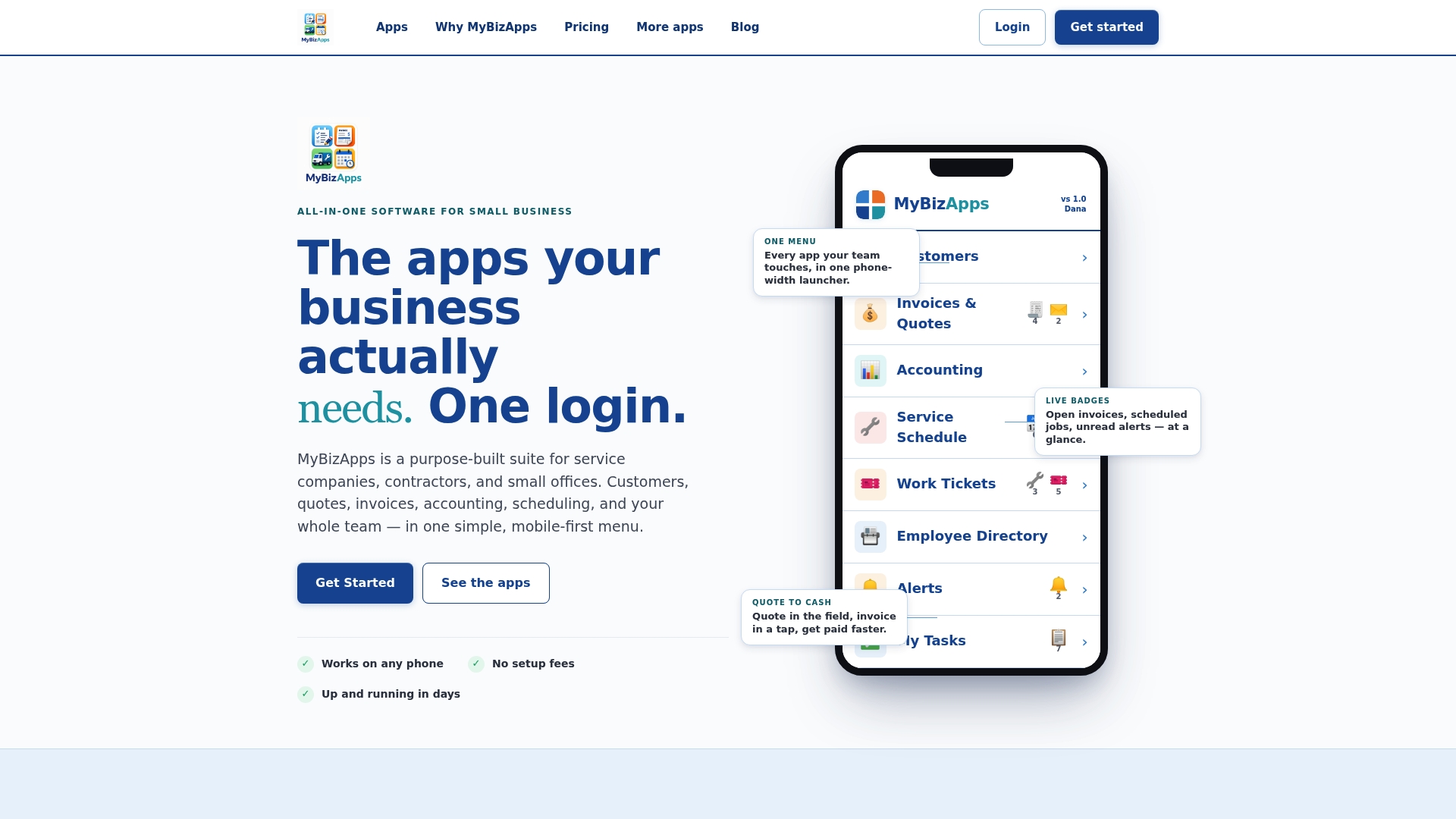
If your crew works in the field, the day-one habit is easiest when the ticket and the invoice are the same record. Our guides to job status tracking and contractor scheduling show how that looks in practice.
FAQ
What is the best way to improve cash flow with invoicing?
Invoice as soon as the work is done and make payment easy. Add clear terms, a pay-now link and automatic reminders. Those four changes address most of the delay you can control.
How soon should I send an invoice?
For one-off service jobs, the same day, ideally right when the work is complete. For long projects, invoice at agreed milestones, and for ongoing work use a steady schedule such as every two weeks or monthly. Whatever you choose, agree it with the customer before work begins.
Should I charge late fees or offer early-payment discounts?
Both can work, but only if they are stated in your terms before the job and printed on the invoice. A discount costs you margin, so use it where faster cash is worth the price. Check any late fee rules that apply in your state, and ask your accountant or attorney if you are unsure.
How do I handle a customer who is always late?
Contact them the first day a payment is overdue, then escalate in steps. For repeat offenders, reset expectations in a direct conversation and require a deposit or payment on completion going forward. Keep the tone factual and always include a link to pay.
When does invoice financing make sense?
It can bridge a temporary gap when you have large unpaid invoices from reliable customers and bills due now. It costs money, so fix your own collection speed first and compare the fees with other options. A lender or accountant can help you check the numbers.
Sources
- Cash flow, invoices and payments, Business Queensland
- How Net 30 Accounts Help Conserve Business Cash Flow, SBA
- Digital Payments Improve Cash Flow and Customer Experience, PYMNTS
- 11 Tips to Improve Your Accounts Receivable Collection, City National Bank
- How should I record my business transactions, IRS
- No Business Credit? A Simple Strategy to Conserve Cash Flow, SBA
- Managing Client Payments and Invoicing for Better Cash Flow, PNC
- 3 Ways to Get Working Capital for Your Business, SBA
- What Makes Up a Small Business Credit Report, SBA