Appointment Cancellation Policy: What to Include and How to Word It
Appointment Cancellation Policy: What to Include and How to Word It

A good appointment cancellation policy does four things: it sets a notice window, names a fee for late cancellations and no-shows, ties that fee to the real cost of the empty slot, and shows up where customers book, not after the damage is done. Most service businesses land on 24 hours’ notice and a fee between a flat charge and half the job. The policy only works if it is visible at booking and applied the same way every time. The scheduling, billing and payment tools in MyBizApps sit under one login, so the policy, the booking and the invoice live in the same place.
TL;DR
- Require 24 hours’ notice for most appointments, and 48 hours for longer or bigger jobs. Both are common windows.
- Base the fee on what the missed slot actually costs you: labor, fuel and the booking you could not fill. A fee that is far larger than that loss can be voided as a penalty.
- Never charge a fee equal to or above the price of the service you did not perform.
- Show the policy at booking, in confirmations and in reminders, and get the customer’s agreement before the appointment, not after the no-show.
- Treat rescheduling as a friendlier path than canceling, and give customers an easy way to do it.
Table of Contents
- What an appointment cancellation policy covers
- How much notice to require
- Fees: what to charge and what is fair
- What to put in the policy
- Where to show it so it holds up
- Handling the cancellations themselves
- Measuring whether the policy works
- Our perspective
- Run your policy from one place
- FAQ
- Sources
What an appointment cancellation policy covers
A cancellation policy is a short set of written rules that says what happens when a customer cannot keep an appointment. It protects the time you set aside: the technician, the chair, the truck, the slot.
Three words matter, and your policy should use them the same way every time:
- Cancel ends the appointment.
- Reschedule moves it to another time.
- No-show means the customer did not arrive and did not tell you within your stated window.
The distinction matters because a reschedule usually costs you less than a cancellation, especially when the original slot can be refilled, as one auto repair guide points out. Many businesses therefore treat a reschedule made inside the notice window as a cancellation plus a new booking, which is how one US spa words it. Either approach is fine. What counts is that customers read it before they book.
A complete policy has five parts: the notice window, the fee triggers, how deposits are handled, a limit on reschedules, and the exceptions you are willing to make.
How much notice to require

The standard answer is 24 to 48 hours. Health billing sources describe it as the range providers typically set, and a home-services marketing guide says 24 hours is the most common for jobs at a customer’s property. The American Dental Association, writing for practices, also suggests considering a fee for cancellations made with less than 24 or 48 hours’ notice.
How to choose inside that range:
| Situation | Suggested notice | Why |
|---|---|---|
| Short visits you can refill quickly (oil change, quick consult) | 24 hours | The slot is easy to rebook, so a long window just annoys customers |
| Home visits and mobile jobs | 24 hours, 48 for multi-hour jobs | Travel and fuel are already spent when a crew is on the way |
| Large installs, full-day jobs, multi-person crews | 48 hours or more | Several people and a whole day are tied up |
| Recurring service | 24 hours per visit | Customers expect to skip a visit now and then |
A short grace period for lateness is also reasonable. One small-business guide suggests 15 minutes before a late arrival counts as missed. State your number in the policy so the front desk is not improvising.
Fees: what to charge and what is fair
There are four common fee structures:
- A flat fee, such as $50 for any late cancellation or no-show.
- A percentage of the job, often half.
- The full price of the missed service.
- A deposit kept, where the deposit paid at booking is the fee.
For home services, one industry guide puts a fair no-show fee from a $50 flat charge up to roughly half the job value on larger bookings, and advises anchoring it to the real cost of the missed slot, meaning fuel and idle labor. That anchoring is the point. It makes the fee easy to explain and easy to defend.
A worked example
Say you run a two-person cleaning crew. A four-hour job is quoted at $320. If the customer cancels two hours before arrival, your crew is already scheduled, you cannot realistically fill the slot, and you have lost most of the day.
- Labor for four hours across two people, at your cost: the real loss.
- Fuel and drive time already planned: part of the loss.
- Chance of rebooking at short notice: low.
A fee of 50% ($160) is easy to justify. A fee of $320 on a job you never performed is not, and a 24-hour rule paired with a flat $50 charge may be all you need for a one-hour visit. Write down how you arrived at each number. The point is to show a reasonable link between the fee and your loss.
Do not charge more than the service is worth
Fees are generally legal in the US, but state consumer-protection laws often limit unreasonable charges, and a no-show fee generally cannot equal or exceed the price of the service not performed. A salon cannot charge $300 for a $200 treatment.
Courts typically look at whether the amount is a reasonable estimate of your actual loss. A legal explainer citing UCC 2-718 and the Restatement (Second) of Contracts says a fee that is unreasonably large is treated as a penalty and voided: $150 on an unfilled $150 session is defensible, $500 is not. The same source recommends keeping a brief note showing each fee was calculated from average lost revenue, staff time and difficulty rebooking.
This is general information, not legal advice. Rules differ by state and by industry, so if you charge large fees or take big deposits, have a business attorney in your state review your wording.
Deposits and the FTC Cooling-Off Rule
No federal law generally bans advance deposits for services. One exception worth knowing: the FTC’s Cooling-Off Rule (16 CFR Part 429) gives buyers three business days to cancel certain door-to-door and other off-premises sales, with a refund of any deposit within 10 business days. It matters if you sell at a customer’s home or at temporary locations. The same source notes that states cap how much contractors can ask for before work begins. Check your state’s contractor rules before you set a deposit percentage.
For how to collect deposits as part of a booking, see our guide to online deposits for service jobs and the companion piece on deposit rules for jobs with online quotes.
What to put in the policy
Use this as a checklist, then trim it to fit your business:
- Notice window: the number of hours before the appointment, and how to cancel (reply to the reminder, call, or use the booking link).
- Late cancellation: what counts and what the fee is.
- No-show: the fee, and how many minutes of lateness count as a no-show.
- Reschedule rule: whether one reschedule is free inside the window, and a cap on repeats.
- Deposits: whether they are refundable, applied to the final invoice or kept.
- Exceptions: emergencies, illness, weather, or a first-time lapse that you may waive at your discretion.
- Payment: how and when a fee is charged, and the customer’s agreement to it.
- Repeat offenders: what happens after a second or third no-show, such as requiring a deposit for future bookings.
If you also teach or tutor, or book sessions online, this tutor cancellation policy example shows how the same elements work in a digital booking flow, including refunds and proof of notice.
Sample wording
Here is wording you can adapt:
To keep our schedule running smoothly for every customer, we ask for at least 24 hours’ notice to cancel or reschedule. Cancellations made with less than 24 hours’ notice, and missed appointments, are charged a fee of [$X / X% of the service price]. If you are more than [15] minutes late without contacting us, the appointment may be treated as a no-show. We understand emergencies happen. Please call us, and we will do our best to work with you. By booking, you agree to this policy.
Notice the tone. One home-services editor argues that framing the policy as a courtesy lands far better than a stern fee warning, and that on a no-show it helps to reach out with empathy before mentioning the fee, since most customers accept it once reminded they agreed to the terms.
Where to show it so it holds up
A policy buried in a footer is hard to enforce. The ADA recommends displaying it prominently and including it in new-patient packages for signature. The same logic applies to any service business. Put it in four places:
- At booking, with a checkbox or a clear line above the confirm button.
- In the confirmation message, repeated in one sentence.
- In the reminder, sent a day or two before, with a one-tap way to reschedule.
- On quotes and invoices, so customers sign off on it with the work.
Clear messaging also matters before a booking exists. Missed calls and slow replies cost contractors jobs, and this piece on missed calls explains why prompt, friendly customer messages are worth the effort.
Handling the cancellations themselves
A policy is only as good as the way you apply it. A few habits keep it fair and keep customers.
Be consistent, then use judgment. Waive the first offense for a regular customer if you want to, but make it your decision, not an accident. The ADA advises applying penalties judiciously because a fee can strain the relationship, and suggests one team member speak with habitual cancellers in a cordial but firm way.
Offer a reschedule first. A customer who moves a visit is easier to keep than one who cancels. For some businesses it helps to rebook the next slot a few weeks out rather than immediately, as the ADA notes where circumstances warrant.
Fill the gap. When a slot opens up, you want to refill it quickly. Our guide to reducing schedule gaps covers how, and preventing double booking keeps a freed slot from being taken twice.
Collect fees promptly and in writing. Send the fee as an invoice with the policy reference and the date the customer agreed. Late fees that sit for weeks become awkward. Our guide to automated payment reminders shows how to set a schedule that gets invoices paid.
Remember insurance. If you work in healthcare billing, cancellation fees are never covered by insurance because no session took place, so the customer owes the whole fee. Say so in the policy.

Measuring whether the policy works
After a quarter, look at three numbers: the share of appointments canceled inside the window, the no-show rate, and the share of late-cancel slots you managed to refill. If the fee is frequently waived, the window may be too long. If late cancellations drop but customers complain, the tone or the fee is too hard. Adjust one variable at a time, and note why, which also helps if you ever need to defend a fee.
Our perspective
Most cancellation problems are not about the rule. They happen because the rule lives in one place, the booking in another, and the invoice in a third. Someone has to remember to connect them.
We built MyBizApps so a service business can run customers, bookings, scheduling, quotes, invoices, accounting and card payments under one login, on a phone. When the booking, the payment and the customer record sit together, a cancellation policy stops being a document in a drawer and becomes part of how a job moves from request to paid.
Our view: write a simple policy, show it where customers book, and spend your energy on making rescheduling easy. Customers who can move a visit in a few taps do not need to cancel.
Philip
Run your policy from one place
If your bookings, schedule and invoices are scattered across tools, enforcing a policy is manual work. MyBizApps gives service companies, contractors and small offices online booking, real-time scheduling and dispatch, quotes and invoices, credit card payment processing and a customer portal under one mobile-first login.
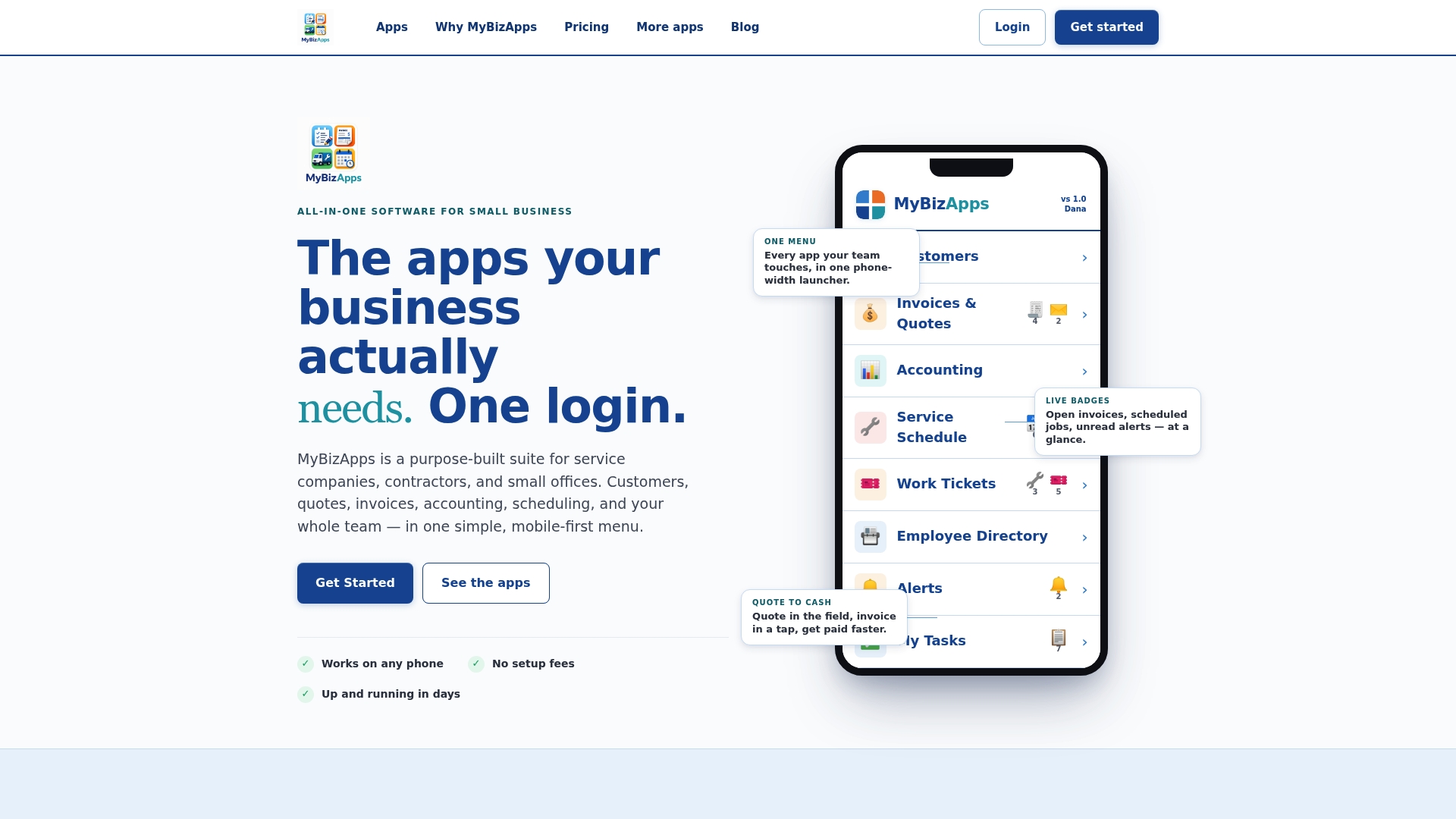
Modules are billed monthly: Bookings, Billing Module, Service Scheduling, Accounting and Customer Portal are each $21 per month. See every module and price on the pricing page.
FAQ
Is canceling an appointment the same as rescheduling it?
No. Canceling ends the appointment, while rescheduling moves it to a new time. Many businesses treat a reschedule as less disruptive, particularly when the slot can be refilled. Your policy should say how each is handled inside the notice window.
Can you give an example of a cancellation fee?
Common examples are a flat $50 charge, 50% of the service price, or the full price for a no-show. For home services, a $50 flat fee up to about half the job value is a typical range. Keep the amount below the price of the service and tied to your real loss.
How much notice should a service business require?
Twenty-four hours is the most common window, and 48 hours suits larger or multi-person jobs. Pick the shortest window that still lets you refill the slot, and state it at booking.
Are cancellation fees legal?
Generally yes in the US, as long as the customer agreed in advance and the fee reasonably reflects your loss. State consumer-protection laws often limit unreasonable charges, so check your state’s rules or ask a business attorney if the amounts are large.
Sources
- Explain Policies: Cancel Or Reschedule Auto Repair Visits
- J Sterling’s Cancellation Policy
- Cancellations and rescheduling, Headway
- Carpet Cleaning Cancellation & No-Show Policy
- Cancellations, American Dental Association
- How to Write a Cancellation Policy: Examples and Tips
- Can Businesses Charge Appointment Deposits and Cancellation Fees? FindLaw
- How to Word a Cancellation Policy: Notices, Fees, and Exceptions
- Are Down Payments Illegal? What the Law Actually Says
- 48 Hours on Tutoroo: Tutor Cancellation Policy, Refunds, and Proof
- Missed Calls: What They Cost Contractors and the Fix