Price Increase Notice: How to Write and Send One
Price Increase Notice: How to Write and Send One

A good price increase notice does five things: it gives customers enough warning, states the new price and the date it starts, gives one honest reason, thanks them for their business, and says who to contact with questions. It goes out directly to each customer, by email or letter, never only as a sign on the counter. Get those pieces right and most customers simply adjust. Get them wrong and a routine change turns into cancellations and awkward phone calls.
This guide is for owners of service companies, contractor businesses and small offices who bill customers every month or per job. You will get the notice periods that work for each type of customer, the rules to check before you send, two ready-to-adapt templates, and a sending routine that keeps your records straight.
TL;DR
- Give recurring and contract customers 30 to 60 days’ notice. For one-off jobs, apply the new price to the next quote or invoice.
- State the exact new price, the exact start date and one reason in plain words. Do not give a range and do not apologize.
- Read your contracts first. Fixed-term agreements usually lock the rate until renewal, and some states set minimum notice periods.
- Send the notice directly to each customer, then repeat it on invoices, your website and your customer portal.
- Keep a record of who was told what and when. It is your best answer to any later dispute.
Table of Contents
- Check your agreements and the rules first
- How much notice to give
- What every price increase notice must include
- Explain the reason without apologizing
- Price increase letter and email templates
- Use more than one channel
- A sending routine that keeps you covered
- Handle pushback calmly
- Our perspective
- Keep pricing, quotes and invoices in one place
- FAQ
- Sources
Check your agreements and the rules first
Before you write a word, find out what you are allowed to do. Small Business guidance from Simply Business says to review active client contracts or service level agreements first, so that your timeline matches your legal and contractual obligations. It also advises making sure your staff understand the new pricing and any customer-specific arrangements before the announcement goes out.
Three questions settle most cases:
- Is the customer under a fixed-term contract? Most fixed-term agreements lock the rate for the term. The increase then applies at renewal, and the contract may already say how much notice you owe.
- Is the customer billed automatically on a recurring basis? Recurring charges are where regulators pay the most attention. Law firm Venable explains that many state laws treat a price increase on a subscription-style offer as a material change that needs clear and conspicuous notice, along with information on how to cancel.
- Does your state or industry set a minimum notice period? Some do. Maine, for example, requires certain service providers to give at least 25 days’ written notice, in a letter, bill message or bill insert, stating the amount, the effective date and the customer’s right to cancel without penalty. Customers not given adequate notice are not obligated to pay the increase, according to the Maine regulation on notification of price increases. That rule covers a specific kind of provider, so treat it as an example of how strict a state can be, not a universal rule.
If you bill customers by card or bank debit on a schedule, or you are unsure which rules apply to your trade and state, ask a business attorney in your state before sending. A short consultation costs far less than refunding a month of disputed charges.
How much notice to give
The right amount of notice depends on how the customer buys from you. The pattern most small service businesses follow is simple: the more regular the relationship, the more warning it deserves. Treat the figures below as a practical standard, and lengthen them whenever a contract or state rule requires.
| Customer type | Practical notice | When the new price applies |
|---|---|---|
| Monthly or retainer customers | 30 to 60 days | First billing cycle after the notice period |
| Customers on a fixed-term contract | Per the contract | At renewal, with notice before renewal |
| Recurring route or maintenance visits | 30 to 60 days | The first visit after the effective date |
| One-time jobs | None beyond the quote | Every new quote and invoice from the effective date |
| New prospects | None | Immediately, on any quote you issue |
Two timing habits make the notice land better. First, honor anything already agreed: a quote the customer accepted, or an appointment booked before the effective date, stays at the old price. Saying so in the notice removes the main reason to feel rushed or tricked. Second, avoid sending the notice in the same week as a late payment, a missed visit or a complaint. A price increase reads very differently after a good job.
If you raise prices on a regular schedule, say once a year, tell customers that in the notice. It makes the next one expected rather than a surprise.
What every price increase notice must include
The U.S. Chamber of Commerce’s guidance on communicating price increases boils the approach down to contacting customers directly, explaining the reasoning, emphasizing what stays the same for them and being transparent. In practice, that means every notice carries these items:
- The service affected. Name it the way it appears on the customer’s invoice, so there is no doubt what changes.
- The old and new price. Give exact figures, for example “$85 per visit becomes $92 per visit.” A range invites haggling.
- The effective date. Use a calendar date, not “next month.”
- One honest reason. Labor, materials, insurance, fuel or the cost of keeping response times where they are. One or two sentences is enough.
- What stays the same. Same crew, same response time, same guarantees, if that is true.
- What the customer needs to do. Usually nothing. If they do need to act, say exactly what and by when.
- How to reach you. A phone number or email address that a person answers.
- Cancellation or change options, where they apply. For recurring billing, the customer should be able to see how to stop or change the service before the new price starts.
Leave out what does not help: long personal cost explanations, comparisons to what other customers pay, hedging words like “we may need to” and any hint of a threat.
Explain the reason without apologizing
The most common mistake is the apologetic opener. Simply Business points out that a hesitant, overly apologetic announcement can signal that the increase is not justified, and recommends confidence, gratitude for past support and transparency. Openers such as “We regret to inform you” tell the reader that you do not believe in your own price.
A better structure runs in this order:
- Thank them. One sentence about the relationship.
- State the change. Service, new price, date.
- Give the reason. One or two sentences, factual.
- Reinforce the value. What they keep getting: reliable scheduling, fast response, clear invoices, a team that shows up.
- Invite questions. Offer a way to talk.
Explaining a technology or service price change well is partly a communications skill. If you want a broader view of how to frame a change in your pricing strategy for subscribers and reduce churn, that is worth reading before you finalize your wording.
Watch for reasons that backfire. “Everything is getting more expensive” sounds vague. “Our materials and insurance costs have risen, and this adjustment lets us keep the same crew and response times” sounds specific and fair, as long as it is true.
Price increase letter and email templates
Adapt the wording to your voice and trade, and change the bracketed items. Keep the finished notice short enough to read in under a minute.
Template for recurring or retainer customers
Subject: An update to your [service] pricing, effective [date]
Hi [First name],
Thank you for trusting [Company name] with [service] for the past [time]. We value working with you.
Starting [effective date], the price of [service] will change from [old price] to [new price] per [visit, month or job]. This adjustment reflects higher costs for [labor, materials or insurance], and it lets us keep the same crew, scheduling and service standards you rely on.
Anything scheduled or booked before [effective date] stays at the current price. You do not need to do anything for the new price to apply. If you would like to change your service plan or have a question, call [phone] or reply to this email and we will go through the options with you.

Thank you for your business.
[Name], [Company name]
Template for one-time and project customers
For customers who buy job by job, a letter is rarely needed. Put the new price on the next quote and add one line: “Our rates were updated on [date] to reflect current labor and material costs.” Quotes already accepted stay as agreed.
Short version for text or a phone call
“Hi [Name], a quick heads-up: starting [date], [service] will be [new price]. Your next [visit/booking] is already set at the current price. Happy to answer any questions.” Follow a phone call with the written version so both of you have a record.
Use more than one channel
A single email gets missed. Repeat the message where customers already look:
- The invoice. Add a line or message on the invoices that go out during the notice period.
- Your website. Publish the updated prices and any revised terms, as Simply Business advises, so that what customers read matches what you charge.
- Customer portal or account page, if you have one. A banner near the top works well.
- Counter sign or in-person mention for walk-in and storefront businesses. A sign is a good reminder, but it does not replace a direct notice to regular customers.
- Your team. Brief everyone who talks to customers, so nobody says “I didn’t know about that.”
A sending routine that keeps you covered
- Decide the change. Set the new prices, the effective date and which customers are affected.
- Sort your customers. Group them as recurring, contract, one-time and prospects, so each group gets the right notice period.
- Check contracts and state rules for the groups with fixed terms or automatic billing.
- Write the notice using the templates above and update your website, quote templates and invoice templates at the same time.
- Send it directly by email or letter, and follow up by phone for your biggest accounts.
- Log every contact. Record who received the notice, by which channel and on what date. Keep any reply. This record is your defense if a customer later disputes the charge.
- Repeat the reminder on invoices and in your customer portal during the notice period.
- Switch the price on the date. New quotes, new invoices and recurring charges all use the new rate from that day.
Steps 2, 6 and 8 are where small businesses most often slip, because customer lists, quotes and invoices live in different places. When they do, someone gets billed the old price after the date or the new price too early. Our guide to logging customer communications shows a simple way to keep the record. Fixed schedules need the same care, so check how your recurring service schedules carry the new rate, and how your quote approval process treats quotes that were accepted before the change.
Handle pushback calmly
Some customers will ask questions or push back. That is normal and does not mean the increase was a mistake. Prepare short, consistent answers:
- “Why now?” Name the cost that changed and the date of the last adjustment, if there was one.
- “Can you keep my old price?” Decide your policy before the notice goes out. If you make exceptions, make them for a reason you can repeat, such as a long-term contract, not for whoever complains loudest.
- “It’s too much.” Do not apologize for the price. Explain what the price covers, and if you can, offer to adjust the scope of work or the frequency of service so the total fits their budget.
- “I’m thinking of leaving.” Thank them, confirm the date the new price starts and what the cancellation steps are. Pressuring a customer into a quick decision usually costs you more than it saves.
After the change, watch your cancellations and late payments for a couple of billing cycles. Customers who stay but pay late may need a clearer invoice or a reminder routine. Setting up automated payment reminders and invoicing on day one helps keep cash flow steady while the new prices settle in. If some customers drift away, a reactivation campaign can bring them back later.
Our perspective
Most price increase problems are record-keeping problems in disguise. The wording of the letter is the easy part. The hard part is knowing, on the effective date, exactly which customers were told, which jobs were already booked at the old price, and which invoices should carry the new one.
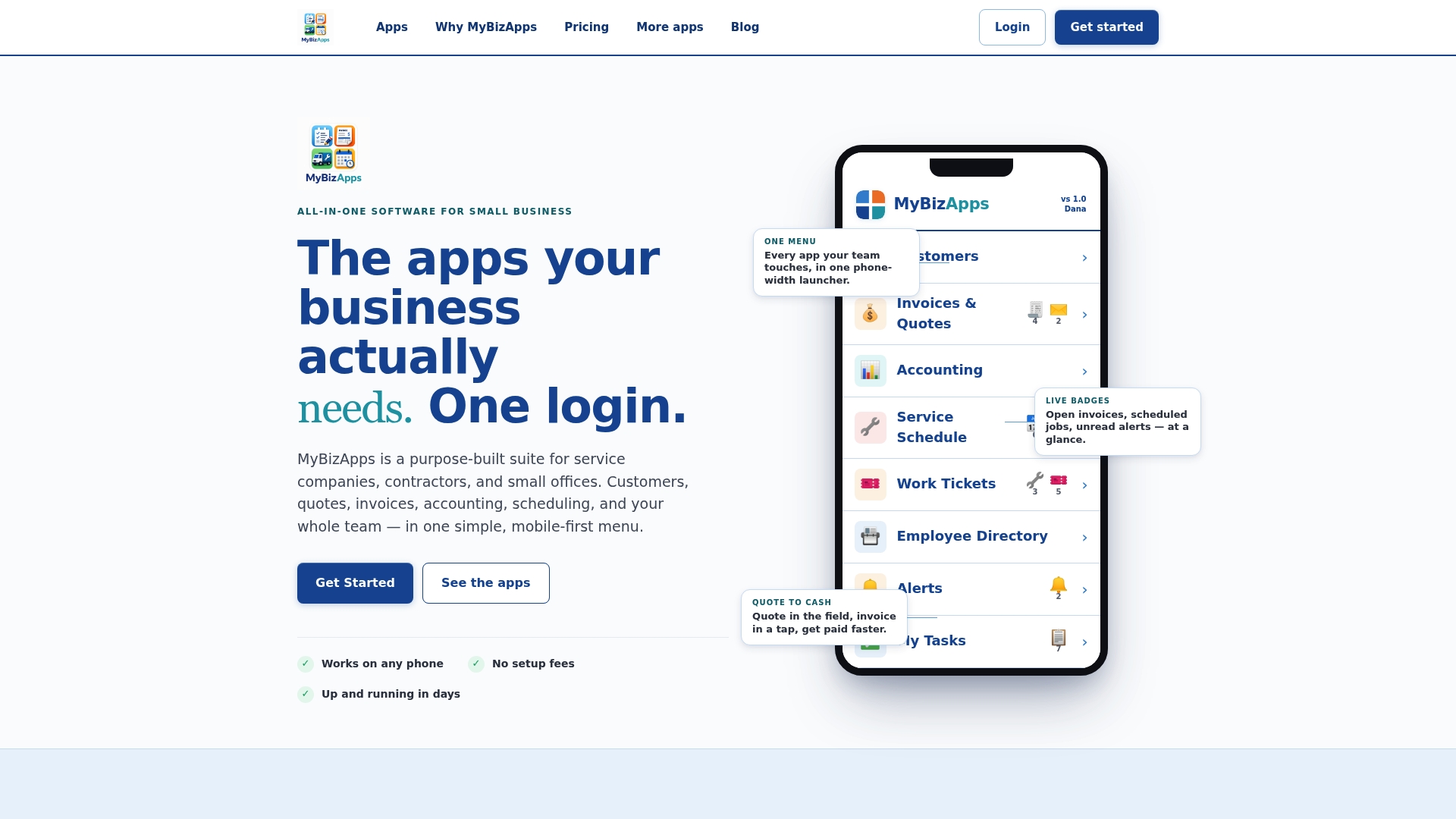
That is why we built MyBizApps around a single login. Customers, quotes, invoices, accounting and scheduling sit in one mobile-first place, so a change in your pricing does not have to be copied across five tools. Our design goal is that the person in the office and the person in the field see the same customer and the same price.
When your customer list, your quotes and your billing agree with each other, a price increase becomes a routine business decision: set the date, tell people early, honor what you already promised, and move on. That is the standard we want small service companies to be able to meet.
Philip
Keep pricing, quotes and invoices in one place
When the price changes, the work moves from the letter to your daily operations. MyBizApps brings customer management, quote and invoice creation, scheduling, accounting and a customer portal together under one login, with every module available as you need it. The Billing Module, Service Scheduling, Accounting and Customer Portal are each $21 per month, so you can add only the parts you use. See the full list of modules and pricing.
FAQ
How much notice should I give for a price increase?
For recurring or retainer customers, 30 to 60 days is a sound standard, and longer is better when the relationship is long or the increase is large. For one-time jobs, the new price simply applies to the next quote. Always check your contracts and any state rules first, since some set a minimum period.
Do I have to give a reason for a price increase?
In most business-to-customer situations, there is no general rule that makes a reason mandatory, but giving one is good practice. One or two honest sentences about your costs or the value you keep delivering is enough. Some state rules do require the notice to state the amount, the effective date and the customer’s cancellation rights.
Can I raise prices for a customer under contract?
Usually only as the contract allows. Many fixed-term agreements lock the rate for the term, so the new price applies at renewal, and the contract may specify the notice period. Read the agreement before you send anything, and ask an attorney if the wording is unclear.
Should I send a letter or an email?
Email is fine for most customers and is easy to record. Use a printed or mailed letter when the contract requires written notice or when the customer prefers paper. Whichever you choose, follow up with a reminder on the invoice and keep a record of the date you sent it.
What should I avoid saying in a price increase notice?
Avoid apologies, vague blame such as “inflation,” comparisons to other customers’ rates, hedging words and anything that sounds like a threat. State the change, the date and the reason, and thank the customer.
Sources
- How to Communicate a Price Increase to Customers, U.S. Chamber of Commerce
- How to Raise Prices Without Losing Your Customers, Simply Business
- 65-407 C.M.R. ch. 291, § 10, Notification of Price Increase, Cornell LII
- Subscription Sellers Take Note, Venable LLP
- Changing pricing strategy, AMAUTA Public Affairs