Progress Billing: How It Works and How to Calculate It
Progress Billing: How It Works and How to Calculate It

Progress billing means invoicing a customer in stages as a job moves forward, instead of sending one bill at the end. Each invoice covers the work finished so far, so your cash comes in while you are still buying materials and paying crews. The method is simple on paper. It gets hard when the schedule, the quote and the invoices live in different places. Our business apps keep quotes, scheduling, invoicing and accounting under one login, so each stage bill starts from the same numbers you quoted.
TL;DR
- Progress billing invoices a customer for the portion of a project completed to date, in stages, rather than once at the end.
- Tie every payment to a visible stage, a fixed amount or percentage, a due date and proof of the work.
- To calculate a bill: value of work completed, minus retainage (if the contract holds any), minus what has already been billed.
- Milestone billing, progress invoicing and partial invoicing are close cousins; the real difference is whether you bill by percent complete or by fixed milestones.
- The method works best when the original quote, the schedule and the invoices all come from one record.
Table of Contents
- What progress billing is
- When it makes sense to bill in stages
- How to build a progress payment schedule
- How to calculate a progress billing amount
- What a progress invoice should include
- Getting progress bills approved and paid
- How progress billing shows up in your books
- Common mistakes to avoid
- Our perspective
- Run your stage billing from one login
- FAQ
- Sources
What progress billing is
Progress billing is an invoice meant to collect payment for the part of a project completed to date. It is used on long jobs where you spend money well before the work is done: lumber, fixtures, subcontractors, payroll. Spreading the invoices across the job also means the customer does not pay everything upfront, while you receive regular payments that cover ongoing expenses such as raw materials.
A typical example: you agree to remodel a kitchen for $48,000. Instead of one invoice on completion, you bill a deposit at signing, a second payment when demolition and rough-in are done, a third when cabinets and counters are installed, and a final payment at walkthrough. That is a progress payment schedule.

Progress billing, milestone billing and partial invoicing
The search terms overlap, and in daily use they mostly mean the same thing: billing in pieces. The useful distinction is how the pieces are sized.
| Term | How the amount is set | Best for |
|---|---|---|
| Progress billing / progress invoicing | Percent of the work complete as of a billing date | Larger jobs with many line items, such as construction |
| Milestone billing / milestone invoicing | A fixed amount when a named stage is reached | Short, clear jobs with distinct phases |
| Partial invoicing | Any invoice for part of the total job or quote | Splitting an accepted quote into several bills |
You can mix them. Many small contractors take a deposit, bill two or three milestones, and hold the last payment for completion.
When it makes sense to bill in stages
Use progress billing when at least one of these is true:
- The job lasts more than a couple of weeks.
- Materials are a large share of cost and you pay for them early.
- The customer is a business, property manager or general contractor that pays against a schedule anyway.
- You have been waiting 30 or 60 days after completion for the whole payment.
A one-visit service call does not need it. A single invoice at the end of the visit, paid by card on the spot, is the right fit. If late payments are your main issue, our guide to day one invoicing covers that side, and the piece on improving cash flow with better invoicing shows how billing timing moves your bank balance.
How to build a progress payment schedule
A good schedule is built from the accepted quote and scope, with each payment assigned to an identifiable job stage, amount, due date and supporting record. Work through it in this order.
1. Start from an accepted quote
The schedule is only as good as the estimate behind it. If the quote is vague, every stage bill becomes an argument. Break the quote into line items the customer can recognize: demolition, framing, electrical, finish work. Our guide on improving estimate accuracy helps here, and the quote approval process article shows how to get a clear yes before work starts. In our platform, quotes and invoices are created in the same place, so stage invoices can be drawn from the quote you already sent rather than retyped.
2. Choose the trigger for each payment
Pick something both sides can verify: “rough-in passes inspection,” “cabinets delivered and installed,” or “drywall hung.” Avoid triggers like “halfway done.” They invite disagreement.
3. Size the payments to your costs
Place the larger payments where your spending is heaviest. Do not front-load. On commercial pay applications, over-allocating value to early items such as mobilization can be grounds for an architect to refuse certification, and on residential jobs it erodes the customer’s trust the same way. A deposit of 10 to 30 percent with the rest tied to stages is common, but your own cost curve should decide.
4. Set due dates and terms
State when each invoice is due after it is sent, and what happens when it is late. Our article on payment terms for contractors has examples you can adapt.
5. Line the schedule up with the work calendar
Stage payments follow stage completion, and stages slip when crews are double-booked. Keeping scheduling next to billing means a finished stage on the calendar is a prompt to invoice. For small crews, see our contractor scheduling best practices.
How to calculate a progress billing amount
There are two common calculations, matching the two common methods.
Fixed milestones
Multiply the contract price by the percentage assigned to the milestone. On the $48,000 kitchen:
| Stage | Share | Invoice |
|---|---|---|
| Deposit at signing | 20% | $9,600 |
| Demolition and rough-in complete | 30% | $14,400 |
| Cabinets and counters installed | 30% | $14,400 |
| Final walkthrough | 20% | $9,600 |
| Total | 100% | $48,000 |
Percent complete by line item
For bigger jobs, list each line item with its contract value (this list is often called a schedule of values), estimate the percent complete for each, and total the result. Here is a $120,000 job at its second billing:
| Line item | Contract value | % complete | Work completed |
|---|---|---|---|
| Framing | $30,000 | 60% | $18,000 |
| Electrical | $20,000 | 50% | $10,000 |
| Plumbing | $15,000 | 80% | $12,000 |
| Drywall | $25,000 | 0% | $0 |
| General conditions and other | $30,000 | 10% | $3,000 |
| Total | $120,000 | $43,000 |
Now apply the contract terms. Assume the contract holds back 10 percent as retainage (a portion of each payment the customer keeps until the job is finished) and that you were paid $15,300 on earlier invoices:
- Work completed to date: $43,000
- Less 10% retainage: $4,300
- Less previous payments: $15,300
- Amount due on this invoice: $23,400
The formula, in words: work completed to date, minus retainage, minus what you were already paid. Always bill cumulatively and subtract earlier payments, so no stage is billed twice.
What a progress invoice should include
A complete progress invoice carries project information, the billing period, an updated schedule of values, work completed, previous payments, the current amount requested, retainage and supporting documentation. On larger jobs the owner, architect, engineer or construction manager may review it before payment.
On commercial work, the standard American Institute of Architects forms do this: G702 summarizes billing and approvals, and G703 lists line-item progress. For residential and small commercial jobs, a clear invoice that shows the stage, the percentage or amount, the running total and the balance remaining is enough.
Support each bill with proof of the work. Field reports, photographs, inspection records and delivery records all work. A photo taken from the job site and attached to the invoice answers most “did you really finish that?” questions before they are asked.

Getting progress bills approved and paid
Most stalled progress bills stall on approval, not arithmetic: the owner wants a sign-off, the numbers do not match their records, or nobody knows who is supposed to approve. Three habits help:
- Agree on the approver in writing before the first invoice: who reviews, how long they have, and how disputes are raised.
- Send the invoice the day the stage is done. Memory and site conditions are freshest then.
- Keep the paper trail in one place. Quote, change orders, photos and invoices should be findable in seconds. Clear updates between your office, your crew and the customer are a project communication habit, and the principles in project communication management apply to billing conversations as much as to the build.
Change orders deserve special care. If the customer adds a feature mid-job, write it up and add it as its own line before billing against it. Otherwise the final bill will not match the original quote and the customer will notice.
How progress billing shows up in your books
The accounting treatment depends on how you recognize revenue, and that is a decision for your CPA, because it affects your taxes and financial statements. What you can do on the operating side is keep clean data: every invoice linked to a job, every payment matched to an invoice, and retainage tracked separately from what is actually due. Invoices you have sent but not been paid for sit as receivables, and retainage held back is a receivable too, collected later. Having invoicing and accounting in one system keeps those entries from drifting apart. Our post on centralizing business data explains why that matters if you ever face an IRS audit.
Common mistakes to avoid
- Billing ahead of the work. Overbilling creates distrust and can create real exposure if the job stops.
- Vague milestones. “Phase two” means different things to you and the customer.
- Forgetting retainage. If your contract has it, track it every cycle so you remember to collect it at the end.
- Retyping numbers. Each manual copy from quote to invoice is a chance for an error.
- Sending bills late. A stage bill sent two weeks after the stage ended is paid two weeks later.
Our perspective
Progress billing fails less often because of the method than because of the tools. When a quote is in one app, the schedule in a spreadsheet and the invoices in a third place, somebody has to remember to connect them, and that somebody is usually the owner at 9 p.m.
We built MyBizApps so customers, quotes, invoices, accounting and scheduling sit under a single mobile-first login. A foreman on site and an office manager can look at the same job status. When the stage is finished, the next step, a clear invoice that matches the quote, is already in the same system.
Our advice to small contractors and service companies: set your stages before the job starts, bill the day they are complete, and keep proof attached. Do those three things and cash flow takes care of itself far more often than not.
Philip
Run your stage billing from one login
If you bill in stages, the pieces you need are a quote, a schedule, an invoice and a place to record payment. Our Billing Module is $21 per month, as are Service Scheduling and Accounting, and you add only the modules you need. Customers can also pay by credit card through the platform, and the Customer Portal module gives them a place to see their documents.
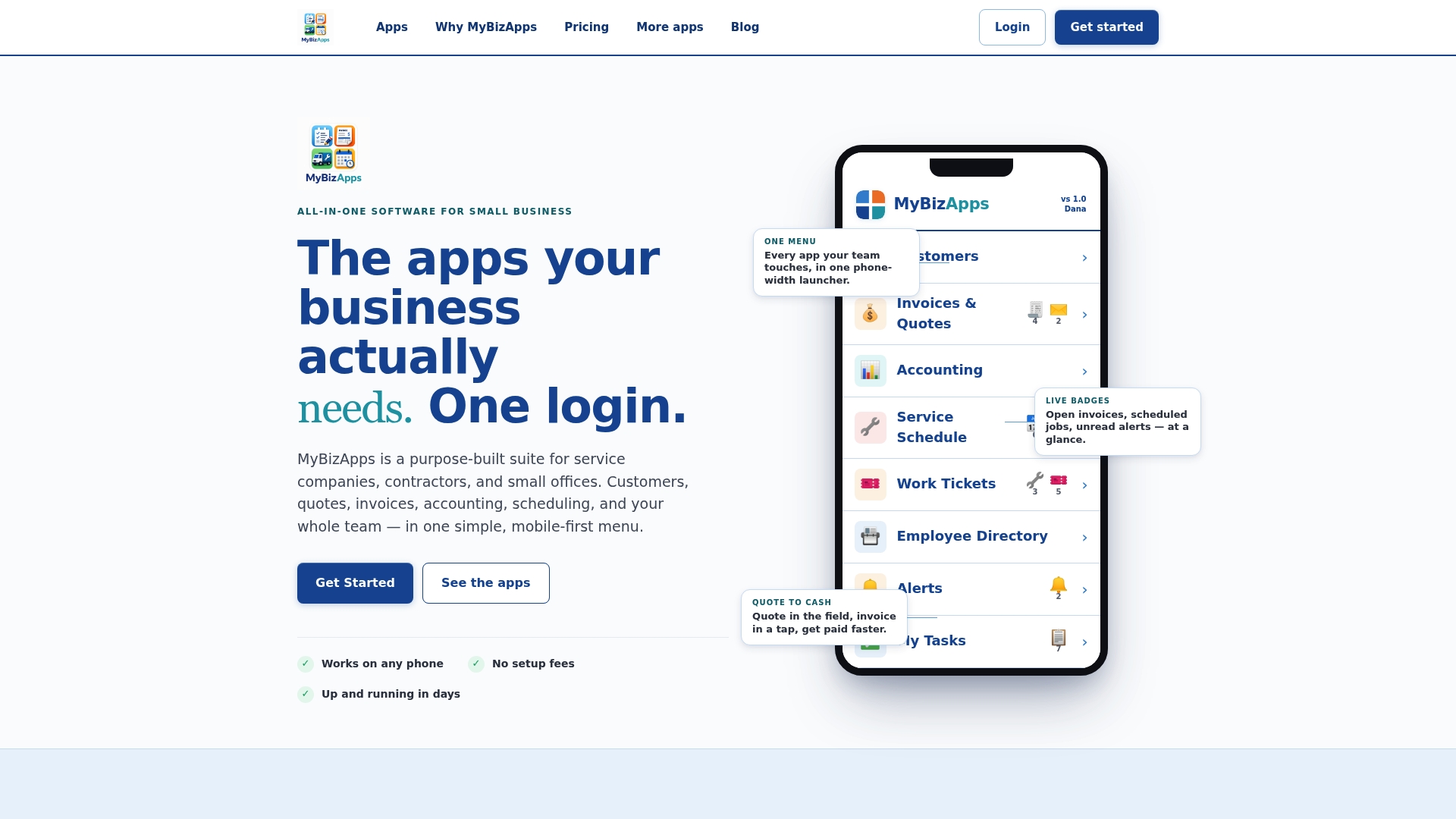
See the modules and prices on our pricing page, or start from the MyBizApps home page.
FAQ
What is the difference between progress billing and milestone billing?
Progress billing charges for the percentage of work done as of a billing date, so the amount varies each time. Milestone billing charges a fixed amount when a named stage is reached. Many small jobs use milestones because they are easier for the customer to check.
What is an example of a progress payment?
On a $48,000 remodel, a $14,400 payment due when demolition and rough-in are complete is a progress payment. It is 30 percent of the contract, tied to a stage both sides can see.
How do you compute a progress billing?
Total the value of work completed to date, subtract any retainage held back, then subtract what you have already been paid. The result is the amount due on this invoice. The worked example above shows it with real numbers.
Can I use progress billing on a short job?
Yes, with fewer stages. A job lasting one to two weeks can use a deposit and a final invoice. If your costs are mostly labor and you are paid quickly after completion, a single invoice may be simpler.
Sources
- Progress billing definition, AccountingTools
- Understanding Progress Billings, Investopedia
- Milestone Billing Schedules for Small Contractors
- Free Construction Invoice Forms
- Progress Payments
- Project Quality and Communication Management