Sales Tax on Services: What Is Taxed and How to Collect It
Sales Tax on Services: What Is Taxed and How to Collect It

Do services get taxed? It depends on the state and on the exact service. Sales tax in the US is set state by state. Some states tax only the services their law lists, a few presume almost every service is taxable, and some tax services only when they involve tangible property, such as repairs, installation or cleaning. Before you add a line of tax to an invoice, you need to know three things: where you do business, what you actually sell, and whether you are registered to collect.
This guide walks through how the rules are built, shows how different states handle services with examples from their own tax agencies, and lays out the steps to register, collect and file. It is written for contractors, service companies and small offices that bill customers every week.
TL;DR
- There is no federal sales tax. Each state decides whether a given service is taxable, so the same job can be taxed in one state and not in the next.
- Most states tax a service only if their law names it. A smaller group starts from the presumption that services are taxable and then carves out exceptions.
- Services tied to physical property (repair, installation, cleaning, building work) are the ones most often taxed, even in states that leave professional services alone.
- You generally collect only after you register with the state. Once registered, you file returns even in periods with no tax due.
- Keep taxable and non-taxable lines separate on every quote and invoice, so your records match what you report.
Table of Contents
- Why the same service is taxed differently from state to state
- State examples that show the range
- Categories of services that tend to be taxable
- Do you have to collect? Nexus and registration
- Sales tax versus use tax on services
- How to register, collect and file, step by step
- Keeping your invoices and records in order
- Our perspective
- Put it into practice with MyBizApps
- FAQ
- Sources
Why the same service is taxed differently from state to state
Sales tax on goods is simple by comparison: a retail sale of a physical product is taxed almost everywhere that has a sales tax. Services are where states diverge, because each legislature decided separately which ones to include.
There are three basic designs.

Taxable only if listed. The state taxes retail sales of goods, and adds specific services by name. Tennessee is a good example: its Department of Revenue publishes a list of services subject to sales tax, including repair or installation of tangible personal property, lodging, cleaning of tangible personal property, parking and storing of motor vehicles, and telecommunication services. If your service is not on the list, it is not taxed.
Exempt unless specifically made taxable. Georgia works this way. In a 2013 letter ruling, the Georgia Department of Revenue explains that sales of tangible personal property are generally presumed taxable, while sales of services are exempt unless specifically designated as taxable.
Taxable unless exempted. West Virginia starts from the opposite assumption. The state tax department’s administrative notice says the Consumers Sales and Service Tax presumes that sales of tangible personal property and services are subject to tax unless specifically excepted or exempted (citing W. Va. Code § 11-15-6).
The practical lesson: never assume. A rule you learned in one state tells you very little about the next, and even inside one state, a service can be taxed in one setting and not in another.
State examples that show the range
A few official sources make the spread clear. The table below summarizes what each agency says in the documents cited. Check each state’s current guidance, since rules and rates change.
| State | How services are treated | What the agency says |
|---|---|---|
| California | Sales tax applies to retail sales of goods, not to charges for performing services | CDTFA, citing Regulation 1501, says the tax applies to gross receipts from retail sales of tangible personal property and not to charges for service performance |
| Georgia | Services exempt unless named | Georgia letter ruling: services are exempt unless specifically designated as taxable |
| Tennessee | Listed services taxed | Department of Revenue list includes repair, installation, cleaning, lodging, parking and telecommunications |
| Washington | Broad range of retail services taxed | Department of Revenue lists building construction and improvement for consumers, cleaning, land clearing and moving earth, and landscape maintenance |
| West Virginia | Presumed taxable unless excepted | State Tax Department notice: services are subject to tax unless specifically excepted or exempted |
| Wyoming | Professional services generally not taxed | State guidance says there are generally no provisions taxing professional services, unless they include sales, repairs, alterations or improvements to tangible personal property, or certain oil and gas services |
The pattern is consistent. Where a state exempts most services, it still reaches the ones that touch physical property. A plumber who installs a fixture, a mechanic who repairs a part or a cleaner who works on tangible goods is more likely to be inside the tax than a consultant who sells advice.
Rates matter as much as rules
When a service is taxable, the total rate often has a state part and a local part. Washington’s Department of Revenue says the state levies 6.5% on retail sales and that local sales tax applies to the same transactions, so the total ends up between 7 and 10 percent. Your invoice has to use the rate for the place where the rules say the sale is taxed, not simply your home rate.
Categories of services that tend to be taxable
Because the rules are state-specific, the most useful habit is to ask what kind of service you sell. Taxable services tend to fall into a few families:
- Services to tangible property: repair, maintenance, installation, cleaning, and storing of vehicles or equipment. Tennessee’s list above is built mostly from this family.
- Services to real property: construction, remodeling, landscaping, land clearing. Washington’s list is a clear example.
- Business services: things like telecommunications, or services provided to other companies.
- Personal and amusement services: lodging, parking, recreation.
- Professional services: advisory, accounting, legal and similar work, which many states leave out of the tax.
- Software and digital services: treated differently by state, with no common national approach.
If you sell a mix, for example a repair that includes parts, labor and a service call, the treatment of each line can differ. That is why separating labor, parts and fees on the quote matters long before an auditor asks.
Do you have to collect? Nexus and registration
Whether a service is taxable and whether you must collect on it are two different questions. The second depends on whether you do business in the state, often called nexus. Colorado’s Department of Revenue says that, in general, any retailer making sales in Colorado must collect the applicable state and state-administered local sales taxes, and that the requirement can apply without a physical presence. The same guide says taxable services and tangible property are covered when a retailer is doing business in the state, and that licensing and collection requirements reach for-profit businesses as well as certain nonprofit and governmental entities making retail sales.
If you work in one state from one shop or one service area, your picture is simple. If you travel across state lines for jobs, ship parts, or sell remotely, check each state’s registration rules or ask a CPA or the state tax agency.
Questions people ask about specific states
New York. New York’s Tax Department explains in Publication 750 that if your business makes sales of property or services subject to sales tax, you must register for sales tax purposes and obtain a Certificate of Authority. Once registered, you are responsible for collecting and remitting state and local sales taxes, and any use tax that may be owed.
Florida. The sources we reviewed do not give a single answer we can state for every Florida service, and the answer turns on the service. Look up your specific service in the Florida Department of Revenue’s guidance for your industry, or ask the department directly, before you set up your invoices.
Connecticut. If you sell goods or taxable services in Connecticut, the Department of Revenue Services says the law requires you to charge and collect sales tax and to file timely returns and pay the state, whether or not you collected the tax from customers.
Sales tax versus use tax on services
Use tax is the other half of the system, and service businesses meet it on the buying side. Washington’s Department of Revenue explains that retail sales tax is imposed on the buyer of goods and retail services, with sellers collecting and remitting it, while use tax is owed when a consumer acquires goods or certain services without paying retail sales tax and uses them in the state. The two taxes carry the same state and local rates, and only one is due on a given purchase.
South Dakota’s Department of Revenue describes use tax as the counterpart of its sales tax: it applies when sales tax was not paid at the time of purchase and the product or service is used in the state, at the same rates and to the same products and services.
For your business, that means a vendor who did not charge tax on something you bought may not be the end of the story. Keep purchase records so you or your accountant can tell what tax was paid and what might be owed.

How to register, collect and file, step by step
The sequence is the same in nearly every state, even though the forms differ.
- Confirm your obligation. Decide which states you do business in, and whether your services are taxable there. Use the state tax agency’s own pages for your service category.
- Register before you collect. You generally cannot charge sales tax until the state has issued your permit or license. In New York this is the Certificate of Authority described above.
- Decide taxability line by line. Split each job into labor, parts, materials, delivery and fees, and mark each one taxable or not under that state’s rules.
- Calculate the right amount. Use the state rate plus any local rate that applies to the sale.
- Remit and file on schedule. New York’s Publication 750 says returns are generally due no later than 20 days after the period ends, and that you must file even if no tax is due. Connecticut says the same: a sales and use tax return is still required for a period even if no tax is due or no business activity was conducted.
Filing dates and frequency vary by state and by your volume, so use the schedule your state assigns you.
A worked example
Say a heating contractor in a state that taxes repairs to tangible property but not consulting visits. A job includes a $90 diagnostic visit, a $140 part and $210 of repair labor. If the state taxes the part and the repair labor but treats the diagnostic as a non-taxable service, tax applies to $350, not $440. If the quote lists only a single $440 total, you have no clean way to show which portion was taxed. The numbers here are an illustration, not a statement of any state’s rule. The habit is what counts: itemize, then apply the state’s rule to each line.
Keeping your invoices and records in order
Most sales tax trouble for service businesses comes from records, not from the law. Three habits help.
- Itemize everything. Separate labor, parts, trip fees and discounts on every quote and invoice.
- Store invoices with the job. When a state asks why you did or did not charge tax, the answer is on the job record: quote, work ticket, invoice, payment.
- Reconcile tax collected against tax owed. Compare what your books show you collected to what you file.
We cover the record-keeping side in more depth in our article on centralizing business data for contractors. Card payments add one more wrinkle: fees and pricing programs change what you show on the invoice, so it helps to understand a compliant cash discount program before you change how you price card payments.
Our perspective
Small service companies rarely get into sales tax trouble because they set out to ignore it. They get into trouble because the quote lives in one tool, the work ticket in another, the invoice in a third and the books in a spreadsheet. By the time someone asks whether a given job was taxable, nobody can say what was charged or why.
That is the problem we built MyBizApps to solve. Customers, quotes, invoices, accounting, scheduling and payments sit under one login, so a job leaves a single trail from the first booking to the paid invoice. When you itemize labor and parts on a quote, that same detail follows the job into billing and accounting. Your office and your crew see the same record, from a phone or a desk.
We do not replace your accountant or your state tax agency, and the taxability call for your service is yours to make with them. What we do is make the facts easy to find: what was sold, to whom, when and for how much. Every module is available as you need it, so you can start with billing and add accounting or scheduling as the business grows.
Philip
Put it into practice with MyBizApps
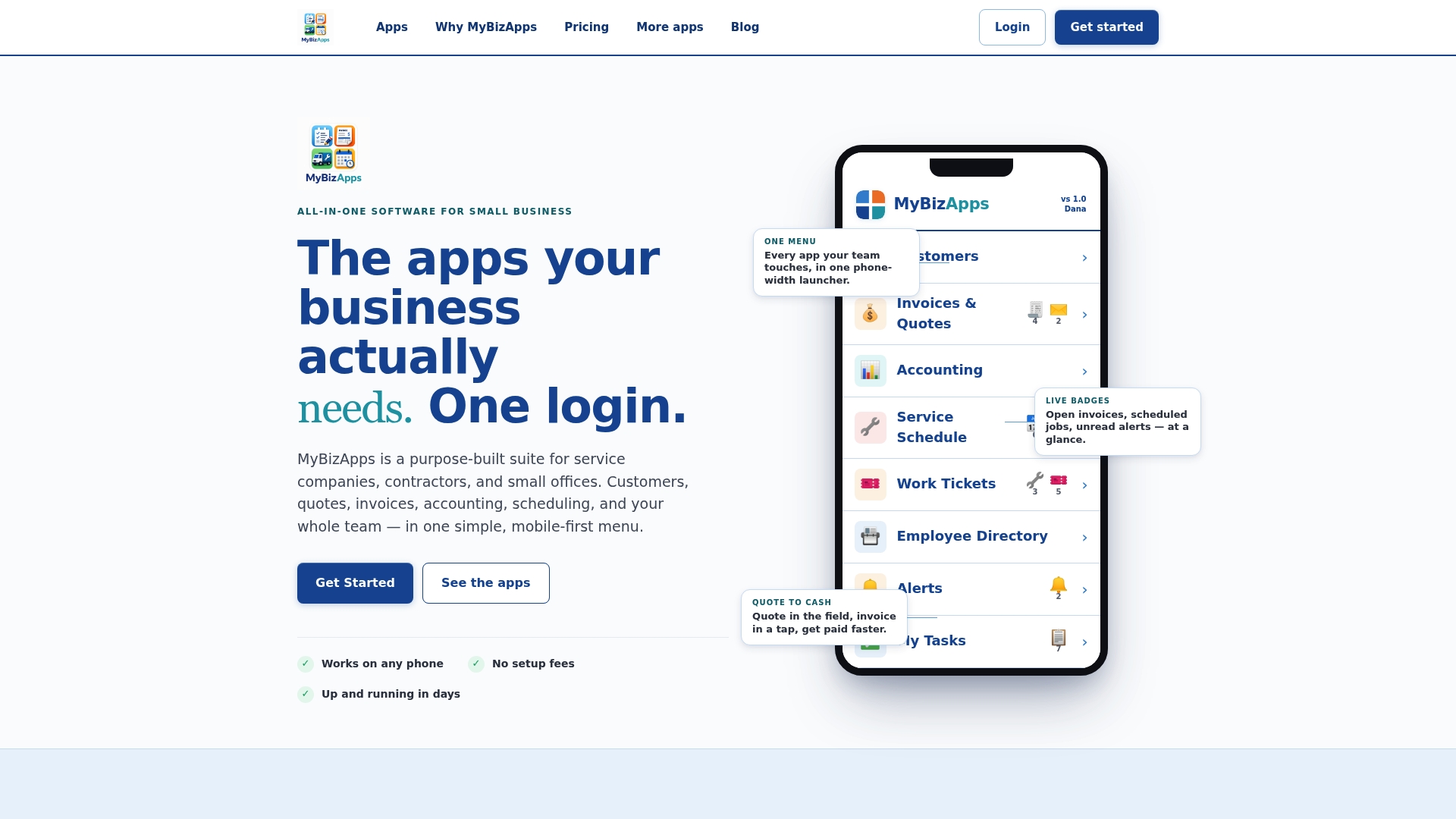
If you are tired of rebuilding the story of a job from three places, MyBizApps brings quotes, invoices, accounting, scheduling and credit card payments into one mobile-first menu. The Billing Module and the Accounting module are each $21 per month, and you can add Service Scheduling or Customer Portal at the same price when you need them. See the current list on our pricing page, or look at the price sheet for the full lineup.
Not sure how modules fit together? Our plain-English explainer on what modular SaaS means walks through how small businesses pick only what they need.
FAQ
Are services subject to sales tax in the US?
Sometimes. There is no federal sales tax, so each state decides. Many states tax only the services their law lists, such as repair or installation, while others presume services are taxable unless exempted. Check your state’s tax agency for your exact service.
Do I have to charge sales tax if I only sell services?
Only if your state taxes that particular service and you do business there. Georgia, for instance, treats services as exempt unless specifically made taxable, while West Virginia presumes they are taxable unless exempted. Look up your service in your state’s guidance.
Do I need to register before I charge sales tax?
Yes, in general. You collect sales tax under a permit or certificate issued by the state, such as New York’s Certificate of Authority. Register first, then add tax to invoices. Your state tax agency can confirm the process and any fees.
Do I file a return if I collected no tax in a period?
Usually yes. New York and Connecticut both say registered businesses must file returns even when no tax is due. Missing a zero return can still bring penalties, so follow the filing schedule your state gave you.
Is a repair with parts taxed differently from a consulting visit?
Often. States that leave professional services alone commonly tax repairs, installation and work on tangible property. Itemize labor, parts and advice separately so each line can follow the right rule.
Sources
- Tennessee Department of Revenue: Services Subject to Sales Tax
- Georgia Department of Revenue letter ruling
- West Virginia State Tax Department administrative notice
- California CDTFA annotation on Regulation 1501
- Wyoming guidance on professional services
- Washington Department of Revenue: Services Subject to Retail Sales Tax
- Washington Department of Revenue: Definitions
- Colorado Department of Revenue: Sales Tax Guide
- New York Publication 750
- Connecticut DRS sales tax information flyer
- South Dakota Department of Revenue: When is Use Tax Owed?
- How to implement a compliant cash discount program